Prevention
What Do You Know About Mammograms?
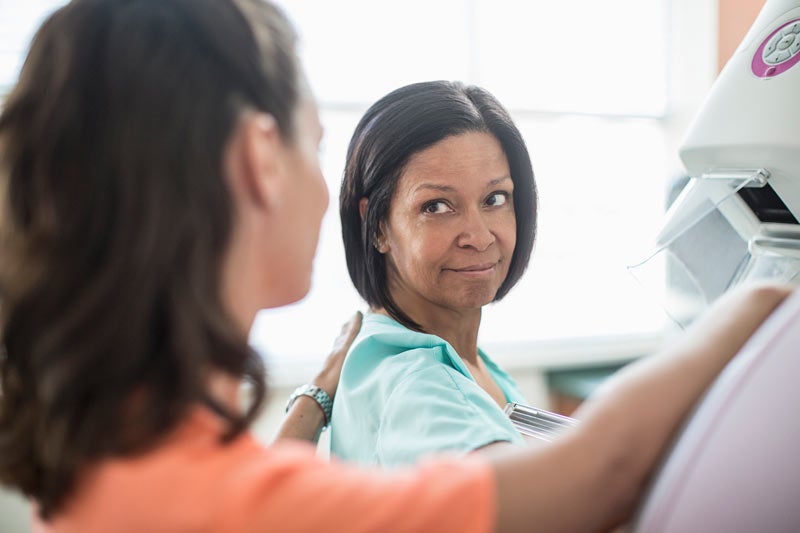
Test your knowledge of what steps to take to catch breast cancer in the early stages.
1. To get a quality mammogram, make sure the facility has which of these?
You didn't answer this question.
You answered
The correct answer is
Also ask if the facility follows FDA quality-assurance programs and if the radiologists who read the mammograms are board certified.
2. Which of these should you bring with you if you start going somewhere else for mammograms?
You didn't answer this question.
You answered
The correct answer is
These X-rays are your property and will help the radiologist compare current films with past ones to spot changes.
3. If you are at average risk for breast cancer, at what age should you have a baseline mammogram?
You didn't answer this question.
You answered
The correct answer is
The benefits and limitations of mammography vary, based on factors like age and personal risk. Experts have different recommendations for mammography. Currently, the U.S. Preventive Services Task Force recommends screening every 2 years for people ages 50 to 74. The American Cancer Society recommends that yearly screening be an option for people at average risk, starting at age 40. The ACS also recommends yearly mammograms be done from age 45 to 54. At age 55, people should switch to mammograms every 2 years, or they may continue yearly screening. Talk with your healthcare provider about your personal risk factors before making a decision about when to start getting mammograms or how often to get them.
4. Which of these shouldn't you use on the day you go for a mammogram?
You didn't answer this question.
You answered
The correct answer is
The chemicals in these products could distort the mammogram imaging.
5. Mammograms most often detect breast cancer in which age group?
You didn't answer this question.
You answered
The correct answer is
Breast cancer occurs more often in people ages 50 and older.
6. What kind of diagnostic test is done if a screening mammogram shows an area that needs closer examination?
You didn't answer this question.
You answered
The correct answer is
A screening mammogram is an X-ray of the breast used to detect breast changes in people who have no signs of breast cancer. It usually involves two X-rays of each breast. Using a mammogram, it is possible to detect a tumor that cannot be felt.
A diagnostic mammogram is an X-ray of the breast used to diagnose unusual breast changes, such as a lump, pain, nipple thickening or discharge, or a change in breast size or shape. A diagnostic mammogram is also used to evaluate abnormalities detected on a screening mammogram. It usually involves more X-rays of the breast from different angles.
A diagnostic mammogram is an X-ray of the breast used to diagnose unusual breast changes, such as a lump, pain, nipple thickening or discharge, or a change in breast size or shape. A diagnostic mammogram is also used to evaluate abnormalities detected on a screening mammogram. It usually involves more X-rays of the breast from different angles.
7. Digital mammography is computer-based. How does it compare with a standard X-ray mammogram?
You didn't answer this question.
You answered
The correct answer is
Digital mammography is a method that records X-ray images in computer code instead of on X-ray film. Research studies so far have not shown that digital images are more effective in finding cancer than X-ray film images. Perimenopausal people with dense breasts may benefit from digital mammograms. From the patient's point of view, digital mammography is done the same way as a regular mammogram.
Your score was:
Featured in
Online Medical Reviewer: Grossman, Neil, MD
Online Medical Reviewer: Wojcik, Stacey, MBS, BSN, RN
Date Last Reviewed: 05/01/2023
© 2000-2026 The StayWell Company, LLC. All rights reserved. This information is not intended as a substitute for professional medical care. Always follow your healthcare professional's instructions.


