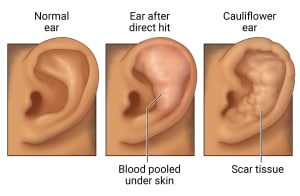
Cauliflower ear is a condition that makes the outer ear look swollen and lumpy (like a cauliflower). It can occur after a direct hit to the ear. It is more common in people who do certain sports, such as boxing, rugby, wrestling, and mixed martial arts. But it can occur any time a direct injury to the outer ear is left untreated. You may hear it called wrestler’s ear.
What causes cauliflower ear?
After a direct hit to the ear, blood can collect under the skin of the outer ear. The ear can become red and swollen. The pooled blood forms a large blood clot (called an auricular hematoma).
Left untreated, this hematoma blocks normal blood flow to the ear cartilage. This is the flexible connective tissue under the outer ear’s skin. The cartilage can’t get the oxygen and nutrients it needs. It can die.
A thick scar tissue then forms, along with new cartilage. But this new cartilage is lumpy, hard, and swollen, like a cauliflower. It is at this point that cauliflower ear occurs.
It’s important to treat an injured ear and an auricular hematoma right away. If they are not treated quickly, cauliflower ear can occur. After 6 to 10 days, the condition can become permanent.
Symptoms of cauliflower ear
Symptoms can include:
-
The outer ear becomes bumpy and lumpy
-
Ear pain
-
Ear bleeding
-
Ringing in the ears (tinnitus)
-
Blurred vision
-
Headaches
-
Facial swelling
-
Hearing loss
Diagnosis of cauliflower ear
Your doctor will examine your ear and ask about symptoms. They will ask about your health history and any direct injury to your ear.
Treatment for cauliflower ear
It’s important to get treatment for any kind of direct ear injury right away—within 6 hours. With early treatment of an auricular hematoma, cauliflower ear may not occur. But if cauliflower ear does occur, it won’t go away on its own. Left untreated, the condition can become permanent after 6 to 10 days. You may be referred to a specialized doctor that treats the ear, nose, and throat (ENT) or a plastic surgeon.
Treatment of an auricular hematoma consists of:
-
Incision and drainage. This should be done as soon as possible after the injury occurs. It must be done by a healthcare provider. The provider will insert a needle into the affected part of the ear. Or they will make a small cut (incision). Then they will drain the blood that has collected. You will then have a bandage put on your ear. You may be prescribed medicines to prevent infection.
-
Surgery. If the ear is not treated right away and cauliflower ear occurs, the damage may be lasting (permanent). Plastic surgery may be needed. Once you have cauliflower ear, it may come back again (recur).
When to contact your doctor
See your doctor right away if you have had an injury to your ear. Even if you think it may not be serious, it’s important to get care quickly. If not, you may have permanent damage to your ear.
If you’ve had treatment for cauliflower ear, contact your doctor right away if you have any of the following:
-
Increasing redness or swelling
-
Increasing pain or tenderness
-
Symptoms that are new or get worse
-
Fever of 100.4ºF (38ºC) or higher, or as directed by your doctor
Date Last Reviewed: 02/01/2025
© 2000-2026 The StayWell Company, LLC. All rights reserved. This information is not intended as a substitute for professional medical care. Always follow your healthcare professional's instructions.


