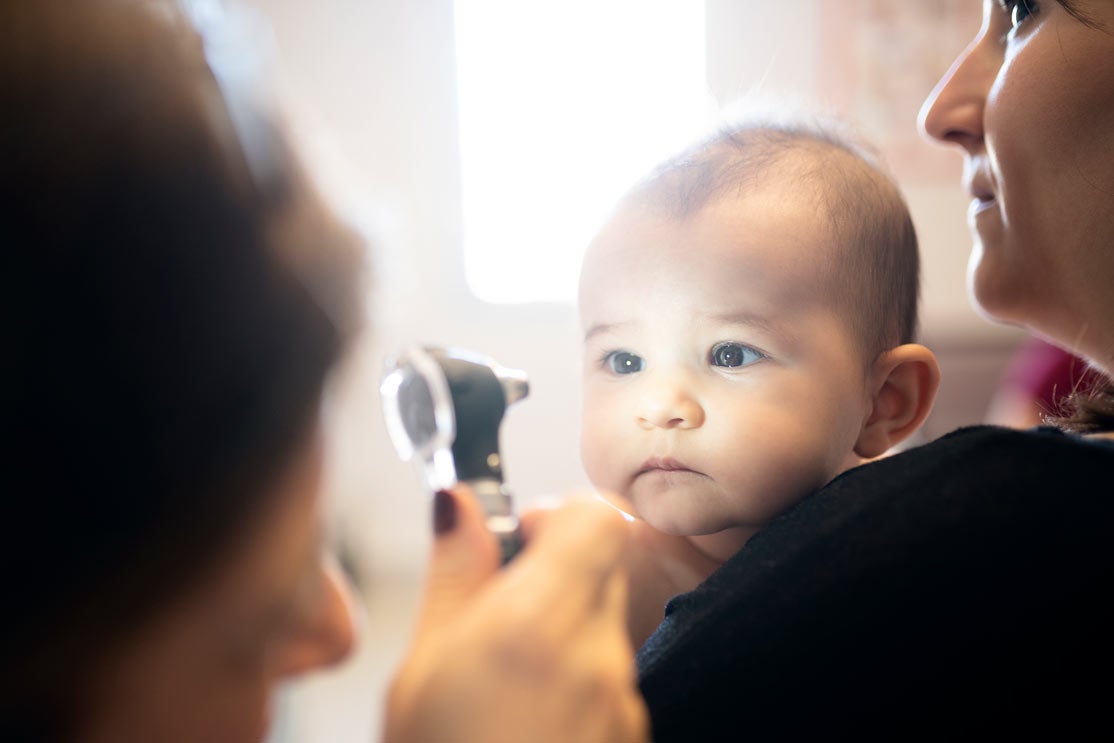
To evaluate your child's vision, your child's healthcare provider will do a health history and physical, including a complete eye exam. There are also many different types of vision tests that can be used to check your child's ability to see. Some of them can be used at any age, while others are used based on your child's age and understanding.
Visual screening tests for a baby
Here are some of the ways your baby's vision can be tested:
-
Response to light. A baby will blink in response to a bright light.
-
Pupil response. Measuring the response of the black center part of the eye (the pupil) by shining a light in the eye.
-
Ability to follow a target. The most common vision acuity test in babies is a test to check the ability to look at and follow an object or toy.
-
Visually evoked potential/response testing. These are tests that stimulate the eyes with either a bright light or special pattern. The baby is connected to a special monitor with attachments on the baby's head. The machine then records electrical activity in the brain as the lights and patterns are shown to the baby.
Visual screening tests for an older baby and toddler
Many of the above tests may be done, as well as the following:
-
Cover and uncover test. This test checks the alignment of the eyes when a child is focusing on an object. One eye is covered with an opaque card while the child stares straight ahead. The examiner then observes the uncovered eye for movement.
Visual screening tests for a preschooler
Around age 3, some of the same tests that are used for a toddler may be done, as well as the following:
-
Visual acuity tests. Specific tests and charts may be used to measure both near and distant vision. In a preschooler, these charts may show pictures or stories instead of letters of the alphabet.
-
Color testing. This test helps find color blindness in a child.
Visual screening tests for a school-aged child
In this age group, formal vision tests can be completed with special charts or devices that aid with testing vision. Both near and far vision can be evaluated.
Featured in



