Dismiss Modal

Treatment

Surgery for Abdominal Aortic Aneurysm

Choose a preferred language

During surgery for abdominal aortic aneurysm, the weakened aortic wall is replaced with a hollow man-made tube (graft).


Reaching the aneurysm

The aorta can be reached through open surgery. Or a less invasive endovascular procedure may be done. Your surgeon will choose the best approach for you.

Open surgery

An incision is made in your abdomen. Inside, your surgeon gently moves aside your organs to reach the damaged section of the aorta.

Endovascular procedure

Near your groin, the surgeon makes two small cuts (incisions). Then they thread a thin, flexible tube (catheter) into the artery at the incision. The surgeon places a graft inside the catheter and guides it toward the damaged part of the aorta.


Placing the graft

The goal is to safely route blood past the aneurysm.


During open surgery

Here is what to expect:

  • The aneurysm is opened and cleaned of any blood clots.

  • The graft is sewn to the aorta.

  • The wall of the aorta is wrapped around the graft to protect it. The wall is then sewn up.

  • The incision site is closed with stitches or staples.
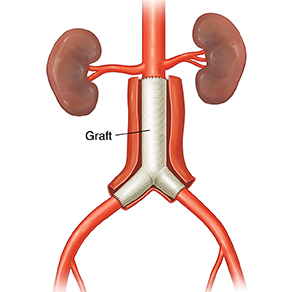
Open surgery to place graft for abdominal aortic aneurysm.


During an endovascular procedure

Here is what to expect:

  • Watching the catheter on a video monitor, the surgeon places a catheter in the best position. This position is confirmed by a dye study (angiogram). 

  • The surgeon guides the graft through the catheter and expands it so blood can flow through it.

  • The blood is now rerouted through the graft and no longer fills the aneurysm.

  • The graft is attached inside the artery. It's held in place with metal springs (stents), hooks, or pins.

  • The catheter is removed. The incision sites are closed with stitches or staples.
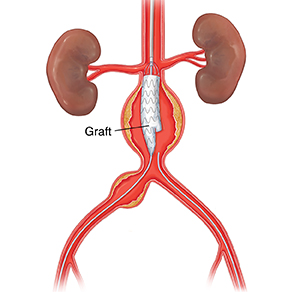
Endovascular procedure to place graft for abdominal aortic aneurysm.


Risks and possible complications

Potential problems to be aware of include: 

  • Infection.

  • Blood clots in legs.

  • Bleeding.

  • Kidney failure.

  • Respiratory failure.

  • Injury to the colon’s blood supply.

  • Erectile dysfunction.

  • Spinal cord injury.

  • Heart attack, stroke, or death.

Featured in

© 2000-2025 The StayWell Company, LLC. All rights reserved. This information is not intended as a substitute for professional medical care. Always follow your healthcare professional's instructions.

Make an Appointment

Make an Appointment

Find a Doctor

Find a Doctor

Find a Location

Find a Location

Related Services

Heart & Vascular Center

Related Articles
Read article
Heart Health
Electrical Cardioversion

You had a cardioversion today. This is an electrical shock applied to the chest. The shock reset your heart rhythm back to normal. Read on to learn how to care for yourself at home.

Read article
Brain Health
AVM: Preparing for surgery

Here you will find out how to prepare for AVM surgery, what to expect the day of surgery, and the risks of surgery.

Read article
Digestive Health
Surgery for GERD (Fundoplication)

GERD is a problem where food and fluid flow back (reflux) into your esophagus. When other treatments don't help, your provider may advise a surgery called fundoplication. Read on to learn more.

Read article
Orthopedics
Foot Surgery: Surgical Settings

Your healthcare provider can tell you where your surgery will be done. You will also be told the type of anesthesia you’ll be given during surgery to stay pain-free during the procedure.


