Pericardiectomy is a surgery to remove part or all of the sac around the heart. This lets the heart move more freely.
Why pericardiectomy is done
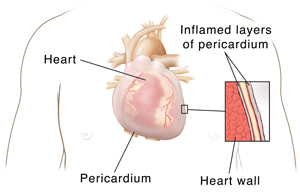
A fibrous sac surrounds the heart. The sac is called the pericardium. It’s made of two thin layers with a small amount of fluid between them. Normally, this sac is thin and flexible. But repeated inflammation can cause it to become stiff and thick. This is called chronic constrictive pericarditis.
When constrictive pericarditis develops, the heart can’t move normally and fill up with as much blood as it should. This can cause increased pressure in the heart, and symptoms such as fatigue and swelling in the body. Cutting the sac away allows the heart to fill normally again. It doesn't fix the problem that caused the inflammation.
How pericardiectomy is done
Your procedure will be done by a cardiothoracic surgeon. This is a doctor who does surgery on the heart, lungs, and other chest organs. Don’t eat or drink for at least 8 hours before the surgery. Your healthcare team may tell you to stop taking certain medicines before the procedure. You may be asked to shower or bathe with soap or a special cleanser the night before and day of surgery. The surgery can be done in more than one way. In general, it goes like this:
-
You will be taken to the operating room and asked to lay on the operating table on your back. You may be given medicine to relax before being transported.
-
The anesthesiologist will place an IV (intravenous) line in a vein in your hand to give you fluid and medicine.
-
You may have additional IV lines placed in your neck. These are to measure the blood pressure in your heart.
-
You will be given medicine to put you into a deep sleep. A breathing tube will be placed down your airway, and you will be connected to a breathing machine.
-
A thin tube will be placed in your bladder to drain urine.
-
The surgeon will make a large incision down the front of your chest over your breastbone and cut the bone lengthwise to expose the pericardium. Or the surgeon will make small incisions in your chest to insert the camera and tools.
-
If the heart-lung machine is needed, an incision may also be made in your groin. A blood thinner will be given in your vein by the anesthesiologist, and a tube will be placed in the artery and vein in the groin so that you can be connected to the heart-lung machine. The machine will take over the circulation of the blood in your body while the surgeon is working on the pericardium.
-
Once the pericardium is removed, if you are on the heart-lung machine, the machine will be gradually turned off and the tubes removed. The incision in your groin will be closed.
-
Tubes will be left in the chest to drain fluid and blood.
-
The breastbone will be closed with wires and the skin will be closed with either staples or suture.
-
You will then be taken to the intensive care unit (ICU) for recovery.
Risks of pericardiectomy
All surgery has some risks. The risks of pericardiectomy include:
-
Not enough oxygen getting out to the body (low cardiac output syndrome)
-
Excess bleeding
-
Damage to the heart muscle
-
Infection
-
Pneumonia
-
Fluid buildup around the lungs
-
Blood clot, which can lead to stroke or other problems
-
Abnormal heart rhythms (arrhythmias) that can cause death in rare cases
-
Heart attack
-
Damage to the blood vessels in the groin
-
Complications from anesthesia
-
Death
Your own risks may vary according to your age, your general health, and the reason for your procedure. They may also vary depending on the structure of your heart and pericardium. Talk with your healthcare provider about which risks apply most to you.



