Endurance exercises help condition your muscles. This helps increase what you are able to do. Exercise also helps improve mood and gives you a sense of well-being. Both are helpful for people with chronic lung disease. These are aerobic exercises, meaning they help your body use oxygen better. Over time, they’ll help you have more energy and less shortness of breath. Talk with your healthcare provider about what kind of exercise plan is good for you. They may also guide you about how long and how hard you can safely exercise.
Wand work
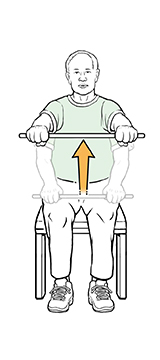
Here are suggestions:
-
Hold a wand or rolled towel on your lap. Keep your back straight and your shoulders relaxed. Inhale.
-
While gently exhaling through pursed lips, lift both arms up to shoulder level. When you’re finished exhaling, inhale and return to the starting position.
-
As you master this exercise, try to lift your arms a little higher each time. The goal is to lift them as high as you can toward the ceiling. Remember to exhale as you lift.
Note: You can also try using a stretchy elastic band instead of a wand. This helps build strength.
Special instructions: _____________________________________________________
Riding a stationary bicycle
Here are suggestions:
-
Adjust the seat so your knees are only slightly bent when the pedals are at their lowest points.
-
Begin to pedal at a comfortable pace. Do pursed-lip breathing as you pedal.
-
In time, your healthcare provider or pulmonary rehabilitation team may suggest adding resistance to make your muscles work harder.
Use the bike for _______ minutes.
Special instructions: _____________________________________________________
Using a treadmill
Here are suggestions:
-
Know how the treadmill works before you use it.
-
Start walking at a comfortable pace. Do pursed-lip breathing as you walk.
-
As you get stronger, your healthcare provider or pulmonary rehabilitation team may suggest increasing speed or adding elevation.
Note: Regular walking is just as good as using a treadmill. Walk on a level surface. You may want to use a walker with wheels. If you use oxygen, you can put the oxygen unit in the basket of the walker.
Walk for _______ minutes.
Special instructions: _____________________________________________________
Pursed-lip breathing
Inhaling through the nose and exhaling through pursed lips makes breathing easier during exercise. To do pursed-lip breathing:
-
Relax your neck and shoulder muscles. Inhale slowly through your nose for at least 2 counts.
-
Pucker your lips as if to blow out a candle. Exhale slowly and gently through your pursed lips for at least twice as long as you inhaled.



