Hands are made up of more bones and moving parts than most other areas of the body. When they’re healthy, these parts all work together. They do a large number of tasks. Hands can make very delicate movements. They can also do tasks that need great strength.
-
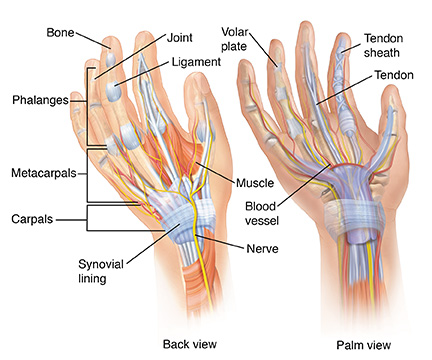
Bones. These are hard tissues that give your hand shape and stability.
-
Phalanges. These are the finger bones.
-
Metacarpals. These are the middle part of the hand bones.
-
Carpals. These are the wrist bones.
-
Joints. These are places where bones fit together, allowing movement.
-
Ligaments. These are soft tissues that connect bone to bone and stabilize your joints.
-
Muscles. These are soft tissues that tighten and relax to move your hand.
-
Synovial lining. This makes the fluid inside your joints that helps make movement smooth.
-
Volar plates. These are hard tissues that stabilize the joints, keeping fingers from bending backward.
-
Tendon sheaths. These are fluid-filled tubes that surround, protect, and guide the tendons.
-
Tendons. These are cord-like soft tissues that connect muscle to bone.
-
Blood vessels. These carry blood to and from your hand.
-
Nerves. These send and receive messages, allowing you to feel and direct movement.
-
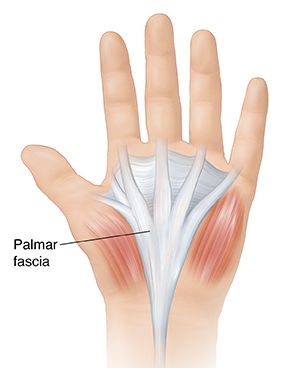
Palmar fascia. This is a firm layer of soft tissue that stabilizes the palm of your hand.



