Corns and calluses are your body’s response to friction or pressure against the skin. If your foot rubs the inside of your shoe, the affected area of skin gets thick. Or if a bone is not in the normal position, skin caught between bone and shoe or bone and ground builds up. In either case, the outer layer of skin gets thick to protect the foot from unusual pressure. In many cases, corns and calluses look bad but are not harmful. But more severe corns and calluses may hurt, become infected, destroy healthy tissue, or affect foot movement.
Corns
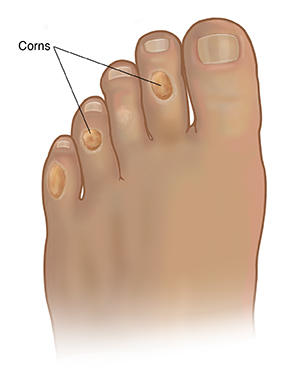
Corns are formed when the skin gets thick with a center core. They can be a painful soft or hard bump. Corns usually grow on top of the foot, often at the toe joint. They often form on top of buckled toe joints (hammer toes). If your toes curl under, corns may grow on the tips of the toes. You may also get a corn on the end of a toe if it rubs against your shoe. Corns can also grow between toes, often between the first and second toes.
Calluses
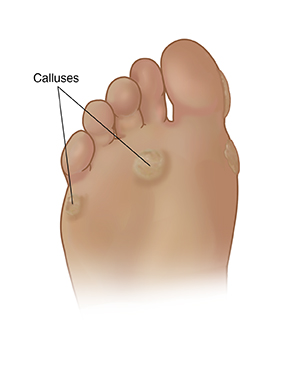
Calluses are a flat, widespread area of the outer layer of skin that gets thick. Calluses can occur on feet and hands. Calluses on the hands may develop from playing a musical instrument or working with your hands. This might be in carpentry or with mechanical equipment. Calluses grow on the bottom of the foot or on the outer edge of a toe or heel. A callus may spread across the ball of your foot. This type of callus is usually from a problem with the long bone at the base of a toe, near the ball of the foot (metatarsal). A pinch callus may grow along the outer edge of the heel or the big toe. Some calluses press up into the foot instead of spreading on the outside. A callus may form a central core or plug of tissue where pressure is greatest.