Dismiss Modal

Treatment

Treating De Quervain Tenosynovitis

Choose a preferred language

The goal of your treatment is to ease your pain and allow you to use your thumb again. Treatment will depend on how bad the pain is.


Nonsurgical Treatment

Just taking a break from the activities that caused your pain may be enough. Your healthcare provider may also have you take nonsteroidal, anti-inflammatory drugs, such as ibuprofen. You may also wear a splint for a few weeks to rest the thumb and wrist. To ease swelling, your healthcare provider may inject an anti-inflammatory medicine, such as cortisone around the tendons. You may have more pain at first. But in a few days your thumb should feel better.


Surgery

If other kinds of treatment don’t ease your pain, or if the pain is bad, you may need surgery. The sheath that surrounds the tendons is released so the tendons can move more easily. This helps reduce the inflammation. It also allows you to straighten your thumb without pain. Surgery is done with local or regional anesthetic on an outpatient basis. So you can go home the same day. You will likely have a splint or dressing on your wrist for a few days while the tissue heals. You may need physical therapy to help make the muscles strong. Your healthcare provider will talk with you about the risks and possible complications of surgery.
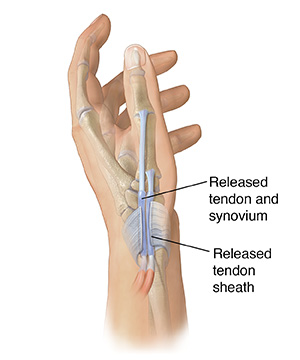
Side view of hand showing tendon sheath cut over tendons in base of thumb to repair DeQuervain's tenosynovitis.

© 2000-2025 The StayWell Company, LLC. All rights reserved. This information is not intended as a substitute for professional medical care. Always follow your healthcare professional's instructions.

Make an Appointment

Make an Appointment

Find a Doctor

Find a Doctor

Find a Location

Find a Location

Related Services

Orthopedics Center

Related Articles
Read article
Orthopedics
Viscosupplementation Treatment for Arthritis

During viscosupplementation treatment for arthritis, your health care provider injects hyaluronic acid into your joint. This thick fluid may help reduce pain and swelling in your arthritic joint (most often, your knee).

Read article
Orthopedics
Foot Surgery: Bunions

A bunion is a bony bump. When the distance between the first and second metatarsal bones of the foot is greater than normal, the big toe may turn toward the other toes. A mild bunion may then form causing foot pain and swelling. Bunions are most often found near the joint at the base of the big toe. Bunions tend to run in families. They may cause pain, swelling, and skin irritation.

Read article
Orthopedics
Understanding Leg Amputation: Surgery for a Medical Condition

This surgery removes part or all your leg. It is done because tissue in the leg is diseased and can't be healed. Or it may be needed to prevent the disease from spreading farther into your body. The goal of the surgery is to restore your ability to function. This is because removing the diseased part of your leg can improve your total health.

Read article
Orthopedics
Dislocation After Hip Replacement, Reduced

After a hip replacement surgery, the ball of the new hip is more easily forced out of its position in the socket. This is called a dislocation.



