Your health care provider can tell if your flexor tendon is cut by examining your finger. If the wound is very deep, the finger may be X-rayed to make sure the bone isn’t damaged or that there are no foreign objects in the wound. If the flexor tendon is cut all the way through or significantly damaged, your provider may recommend surgery to rejoin the two ends of the tendon and repair any other damaged tissue. After surgery, you’ll need to follow a specific exercise program to regain movement in the finger.
Your surgery
-
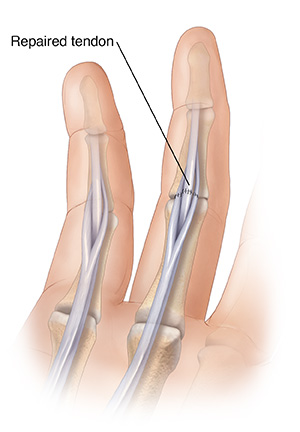
Your surgeon first exposes the cut tendon often with a zigzag-shaped incision.
-
Then they find the two separated ends and stitch them back together. In some cases, your surgeon may need to graft a new tendon to replace the cut one.
-
Nerves, blood vessels, and other soft tissue may also need to be repaired.
-
Surgery generally takes 2 to 3 hours. You may be given anesthesia to make you sleep, or only the hand and arm may be numbed. In either case, you feel no pain during surgery. You can usually go home the same day.
Starting your recovery
It could take up to 2 months until the repair heals and you are able to use your hand without protection. Your hand may be in a splint or cast for several weeks after surgery. This protects the tendon as it heals. You will probably start a gentle exercise program soon after surgery. Exercising your finger as directed by your health care provider or physical therapist is very important. Surgery creates scar tissue inside the finger. Without regular exercise, this tissue will stick to the tendon and the bone, which restricts motion. Then you won’t be able to bend your finger easily. As the tendon heals, you’ll slowly begin to strengthen the tendon and muscles, and move your finger more. Recovery usually takes 3 to 4 months. Often surgery does not return the finger to normal function. Sometimes your surgeon may offer a second surgery to remove or release scar tissue.



