Dismiss Modal

Treatment

Wrist Arthroscopy: Conditions Treated

Choose a preferred language

Wrist arthroscopy is used for diagnosis and treatment. It works best for showing ligament tears, damage to the triangular fibrocartilage complex (TFCC), or joint cartilage. Since the wrist is a very small joint, the surgeon uses a special arthroscope.


Ligament tears

The ligaments between the bones of the wrist can tear. This most often happens between the lunate and scaphoid bones or the lunate and triquetrum bones. Such tears can cause pain, swelling, and a weak grip. With a full tear, the bones may pull apart and limit motion. To perform repairs, your surgeon may shift to open surgery.
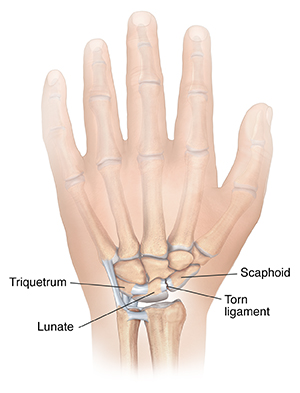
Back view of hand showing torn ligament in wrist.


TFCC damage

Injury or constant use over time can cause a tear in the TFCC (triangular fibrocartilage complex). During surgery, the tear may be shaved off or repaired. Bone or cartilage fragments may be removed. After healing, you should be able to move your wrist with greater ease and less pain.
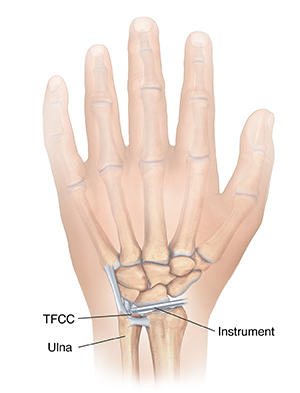
Back view of hand showing instrument repairing damaged cartilage in wrist.


Cartilage damage

If you have wearing down of the cartilage (arthritis), your surgeon will shave off or smooth the worn area. Bone or cartilage fragments that have chipped off in the joint (loose bodies) will be removed. The removal of loose bodies can help restore smooth, pain-free wrist movement.
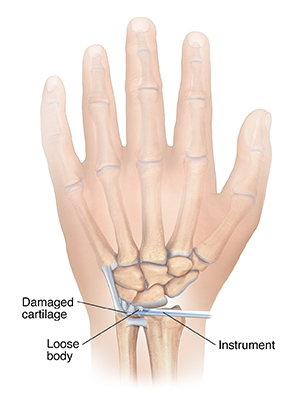

Back view of hand showing instrument removing loose body from joint in wrist.

© 2000-2025 The StayWell Company, LLC. All rights reserved. This information is not intended as a substitute for professional medical care. Always follow your healthcare professional's instructions.

Make an Appointment

Make an Appointment

Find a Doctor

Find a Doctor

Find a Location

Find a Location

Related Services

Orthopedics Center

Related Articles
Read article
Orthopedics
Foot Surgery: Bunions

A bunion is a bony bump. When the distance between the first and second metatarsal bones of the foot is greater than normal, the big toe may turn toward the other toes. A mild bunion may then form causing foot pain and swelling. Bunions are most often found near the joint at the base of the big toe. Bunions tend to run in families. They may cause pain, swelling, and skin irritation.

Read article
Orthopedics
Understanding Leg Amputation: Surgery for a Medical Condition

This surgery removes part or all your leg. It is done because tissue in the leg is diseased and can't be healed. Or it may be needed to prevent the disease from spreading farther into your body. The goal of the surgery is to restore your ability to function. This is because removing the diseased part of your leg can improve your total health.

Read article
Orthopedics
Dislocation After Hip Replacement, Reduced

After a hip replacement surgery, the ball of the new hip is more easily forced out of its position in the socket. This is called a dislocation.

Read article
Orthopedics
Total Shoulder Replacement Surgery

During shoulder replacement surgery, all or part of your problem shoulder is replaced with an artificial joint, called a prosthesis.


