Dismiss Modal

Types

Understanding Hip Fractures

Choose a preferred language

The hip is one of the largest weight-bearing joints in the body. It’s also a common place for a fracture after a fall—especially in older people. Hip fractures are even more likely in people with osteoporosis, a disease that leads to weakened bones.


A healthy hip

The hip is a ball-and-socket joint where the thighbone (femur) joins the pelvis. When the hip is healthy, you can walk, turn, and move without pain. The head or ball of the femur fits into a socket in the pelvis. The ball and socket are each covered with smooth cartilage. This allows the ball to glide easily in the socket. Blood vessels supply oxygen and nutrients to keep the hip joint healthy.
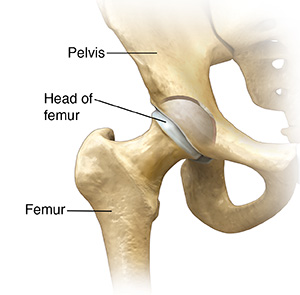
Front view of hip joint.


A fractured hip

The hip can fracture in many places. Most often, the fracture occurs in the upper part of the femur. In rare cases, you can also have more than one type of fracture at a time:

  • Transcervical fracture. A break across the neck of the femur, just under the ball. This type of fracture can interrupt blood flow to the joint.

  • Intertrochanteric fracture. A break down through the top of the femur.

  • Subtrochanteric fracture. A break across the upper shaft of the femur.
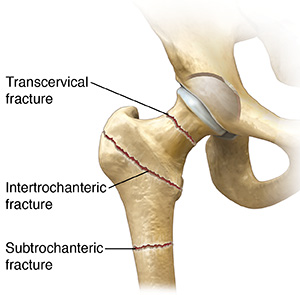
Front view of hip joint showing three types of hip fractures.

© 2000-2025 The StayWell Company, LLC. All rights reserved. This information is not intended as a substitute for professional medical care. Always follow your healthcare professional's instructions.

Make an Appointment

Make an Appointment

Find a Doctor

Find a Doctor

Find a Location

Find a Location

Related Services

Orthopedics Center

Related Articles
Read article
Orthopedics
Foot drop

Foot drop is a disorder that makes it hard to raise the foot at the ankle. There may also be pain, weakness and numbness in the foot.

Read article
Orthopedics
Understanding Lateral Epicondylitis

This condition, also called tennis elbow, is an inflammation around the bony knob (lateral epicondyle) on the outer side of the elbow. It occurs when the tissue that attaches muscle to the bone becomes irritated.

Read article
Orthopedics
Back Sprain or Strain

Learn how to care for your back sprain or strain at home.

Read article
Orthopedics
Broken Wrist

A wrist fracture may be a small crack or chip in the bone. Or it may be a major break, with the broken parts pushed out of position. Wrist fractures are treated with a splint or cast, though severe injuries may also need surgery. Here's what you need to know as you recover at home.



