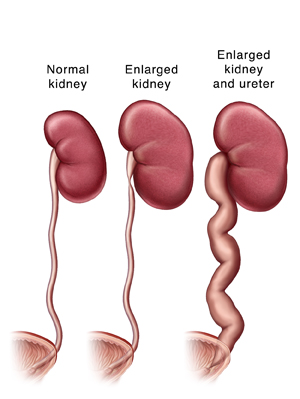
One or both of your child’s kidneys is enlarged because of a backup of urine. This is called hydronephrosis. The problem may have been diagnosed before your child was even born. In some children, the problem is mild and goes away with time on its own. In other children, it will need treatment. Your child’s doctor can tell you about treatments. Your child may see a pediatric urologist or nephrologist. These are specialists who manage problems of the urinary tract in children.
What is hydronephrosis?
The urinary tract includes the kidneys, ureters, bladder, and urethra. Hydronephrosis is swelling of a kidney. It's caused by a backup of urine from the bladder to the kidney. It may be mild, moderate, or severe.
What causes hydronephrosis?
There can be several causes of urine backup. There may be a blockage in the urinary tract that does not let urine flow normally. Urine may also flow the wrong way (reflux) back up to the kidneys. Or urine may drain too slowly down from the kidneys. In rare cases, the blockage may be in the kidney itself. These problems can lead to a swollen kidney if they aren't treated. They may also cause lifelong (permanent) damage to the kidney. Tests will be done to find the cause of your child's condition. The doctor will discuss all the treatment choices with you.
How is hydronephrosis diagnosed?
A swollen kidney may be seen on ultrasounds done during pregnancy. Once the baby is born, tests may be done to see if it is hydronephrosis. This test is called a kidney (renal) ultrasound. Urine that does not flow normally can lead to a urinary tract infection (UTI). A kidney ultrasound test may be done if a baby or child has a UTI. Depending on your child's overall health, your doctor may also use other tests to diagnose the cause.
How is hydronephrosis treated?
Treatment depends on the cause of the urine backup. It also depends on how bad it is. A mild problem may go away on its own without treatment. If the problem was found with prenatal ultrasound, treatment may wait until the baby is born. The goal of treatment is to protect the kidneys as they grow. Your child’s doctor can talk with you about how best to treat your child. Your child may need:
-
Follow-up ultrasounds to check kidney health.
-
Surgery to improve urine flow if the problem is severe.
-
Antibiotics to treat any UTI. If your doctor prescribes antibiotics, give them to your child as directed. Do not stop giving them just because your child feels better. The full course of antibiotics must be taken.
What are the long-term concerns?
A mild case of hydronephrosis may cause no problems. But a severe case or one that gets worse can lead to kidney damage. Your child’s condition will be watched closely. If needed, treatment can be done to prevent long-term problems.
Featured in



