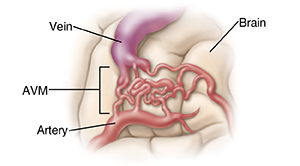
You have an arteriovenous malformation (AVM). An AVM is an abnormal tangle of blood vessels that causes irregular connections between arteries and veins in the brain. Some AVMs never burst (rupture). But some things can lead to a rupture. Some of these factors are known, such as a rise in blood pressure. And some factors are not known.
If you have an AVM, you were likely born with it. Many people don't know they have AVM until a problem develops. Signs of an AVM include:
-
Bad headaches
-
Sudden or gradual paralysis or loss of sensation
-
Blurred or double vision
-
Jerking movements that you can't control (seizures)
Understanding an AVM
The brain controls the body. You can move and feel because of the brain. And it is the brain that makes you able to think, show emotions, remember, and make judgments. An AVM can damage the brain and put the rest of the body in danger.
Inside the skull
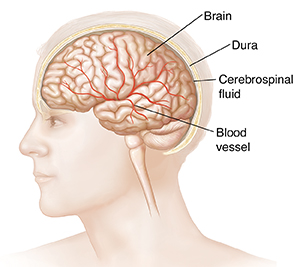
Under the scalp and the skull, a tough membrane (called the dura) surrounds the brain. Beneath the dura, cerebrospinal fluid (CSF) cushions the brain. Blood vessels carry nutrients and oxygen-rich blood throughout the brain.
A problem with blood flow
An AVM is a tangle of blood vessels. It can cause pressure to build up in the blood vessel and prevent normal blood flow. If the pressure becomes too great or the wall of the AVM vessel weakens, a blood vessel can burst and blood can leak or spurt into the brain. This can damage parts of the brain that control vital body functions, such as sight, sensation, language, critical thinking, and movements. In some cases, problems caused by an AVM can even lead to death. The high blood flow in an AVM can also shunt the oxygen from the arteries directly to the veins, bypassing the brain capillaries. This shunting can lead to strokes. AVM can be treated based on the type, symptoms, and cause.
Online Medical Reviewer: Joseph Campellone MD
Online Medical Reviewer: Raymond Kent Turley BSN MSN RN
Online Medical Reviewer: Rita Sather RN
Date Last Reviewed: 04/01/2024
© 2000-2026 The StayWell Company, LLC. All rights reserved. This information is not intended as a substitute for professional medical care. Always follow your healthcare professional's instructions.


