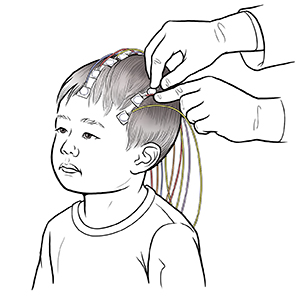
An electroencephalogram (EEG) is a test that measures the electrical activity of the brain. Your child may need this test to check for seizures or other nervous system conditions. Small, round discs with wires (electrodes) are attached to the scalp during the test. The electrodes aren't harmful to your child. An EEG often takes about
Before the test
Follow all instructions given by the technologist and your child’s doctor to prepare your child for the test.
-
Normally, an EEG is done while your child is awake. Sometimes, recording must also be done while your child is drowsy or asleep. In these cases, you’ll be asked to reduce the amount of sleep your child gets before the test. This may mean your child has to stay up later and get up earlier than normal. Sometimes, a flashing light (stroboscope) might be used for a few minutes during the EEG recording.
-
Don't use any hairstyling products (such as oils) in your child’s hair before the test. Any hair extensions or braids should also be removed. These may interfere with the placement of the electrodes during the test.
-
If your child is taking any medicines, let the doctor know before the test. Some medicines may need to be stopped if they can interfere with test results.
Important
For your child’s safety and the success of the test, let the technologist know if your child:
-
Takes any medicines.
-
Has a history of seizures.
-
Has any health problems.
During the test
An EEG is done by a trained technologist. During the test, the electrical activity of your child’s brain is recorded on a computer. In addition, a video camera may be used to record your child’s physical activity. You can stay with your child in the testing room. Your child can bring a favorite toy, such as a stuffed animal, for comfort.
-
The technologist begins by placing the electrodes on your child’s scalp. A special glue, paste, or water-based gel is used to help keep the electrodes in place. The glue's smell can be very strong and unpleasant. But it's not painful.
-
During the test, your child lies down on a hospital bed. If your child is drowsy or asleep for part of the test, the technologist may actively wake your child at a later point.
-
Your child may be asked to do some simple commands, such as:
-
Open and close their eyes.
-
Breathe fast and deep (hyperventilate). (For young children, blowing on a pinwheel may help with this task.)
-
Sense a bright flashing light through closed eyes.
-
Go to sleep.
-
-
If you notice signs that your child may be having a spell or seizure, tell the technologist right away.
After the test
Here is what to expect:
-
Once the test is complete, the electrodes are removed. Any glue, paste, or gel is cleaned from the scalp.
-
Unless told not to, your child can return to their normal routine.
-
Schedule a follow-up appointment with your child’s doctor to review the results of the test.
-
Let the doctor know if symptoms or seizures worsen after the test.
Helping your child get ready
Many hospitals have people trained in helping children cope with their medical care or hospital experience. These people are often called child life specialists. Check with your child’s doctor if child life programs or other similar services are available for your child. There are also things you can do to help your child get ready for a test or procedure. How best to do this depends on your child’s needs. Start with the tips below:
-
Use short and simple words to describe the test to your child and why it’s being done. Younger children tend to have a short attention span, so do this just before the test. Older children can be given more time to understand the test in advance.
-
Tell your child what to expect in the hospital during the test. For instance, you could talk about who will be doing the test and what the hospital room will look like.
-
Make sure your child knows which body parts will be involved in the test.
-
As best you can, describe how the test will feel. For instance, an electrode may be placed on the skin. The electrode is round and may feel sticky.
-
Let your child ask questions. Answer these questions truthfully. Your child may feel nervous or afraid. They may even cry. Let your child know that you’ll be nearby during the test.
-
Use play when telling your child about the test, if appropriate. With younger children, this can include role-playing with a child’s favorite toy or object. With older children, it may help to read books or show pictures of what happens during the test.
Online Medical Reviewer: Anne Fetterman RN BSN
Online Medical Reviewer: Joseph Campellone MD
Online Medical Reviewer: Raymond Kent Turley BSN MSN RN
Date Last Reviewed: 09/01/2025
© 2000-2026 The StayWell Company, LLC. All rights reserved. This information is not intended as a substitute for professional medical care. Always follow your healthcare professional's instructions.


