Dismiss Modal

Types

Types of Brain Aneurysms

Choose a preferred language

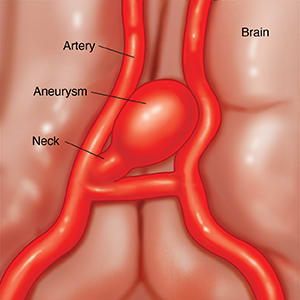
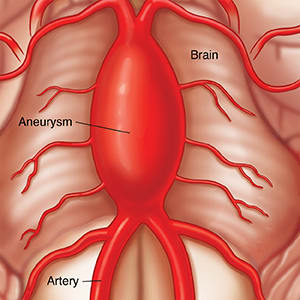
There are several types of brain aneurysms that are classified by shape. These are saccular (also called berry) aneurysms, which are by far the most common. Less common are the fusiform and dissecting types. Brain aneurysms may also be classified by:

  • Size (small, large, and giant)

  • Location

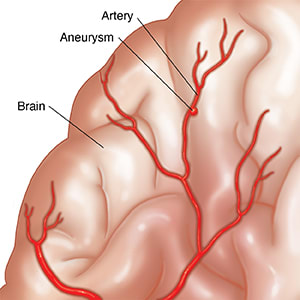
  • Cause (such as a mycotic aneurysm, caused by an infection)

Most aneurysms occur where an artery branches, often at the base of the brain. The risk of an aneurysm bursting (rupturing) can be affected by the shape and location of the aneurysm. The treatment options vary, depending on the type of aneurysm, its size, and its location.
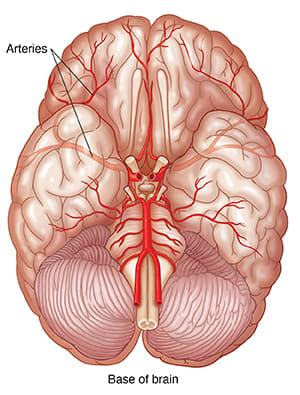
Brain viewed from bottom showing brain stem, cerebellum, and arteries.

Closeup of brain showing artery with saccular aneurysm.

Closeup of brain showing artery with fusiform aneurysm.

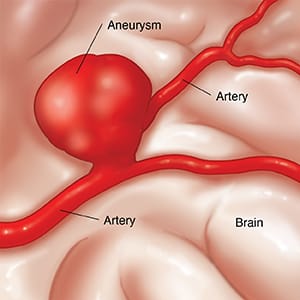
Closeup of brain showing giant aneurysm involving two arteries.

Closeup of brain showing mycotic aneurysm on artery.

© 2000-2025 The StayWell Company, LLC. All rights reserved. This information is not intended as a substitute for professional medical care. Always follow your healthcare professional's instructions.



Make an Appointment

Make an Appointment

Find a Doctor

Find a Doctor

Find a Location

Find a Location

Related Services

Stroke & Neuroscience Center

Related Articles
Read article
Brain Health
Huntington Disease

Huntington disease is a brain disorder that can lead to emotional disturbances, loss of intellectual abilities, and uncontrolled movements.

Read article
Brain Health
Understanding Reversible Dementias

Many factors can cause symptoms that mimic Alzheimer disease. These symptoms are known as reversible dementias. Unlike Alzheimer disease, they can be cured with proper treatment. Here are factors that may lead to reversible dementias.

Read article
Brain Health
Understanding Headache Pain

Headache pain can start in different structures in the head. The brain itself doesn't hurt, but other parts of the head do. Very rarely are headaches a sign of a serious medical problem.

Read article
Brain Health
Bell’s Palsy

Bell's Palsy is a problem involving the nerve that controls the muscles on 1 side of the face.