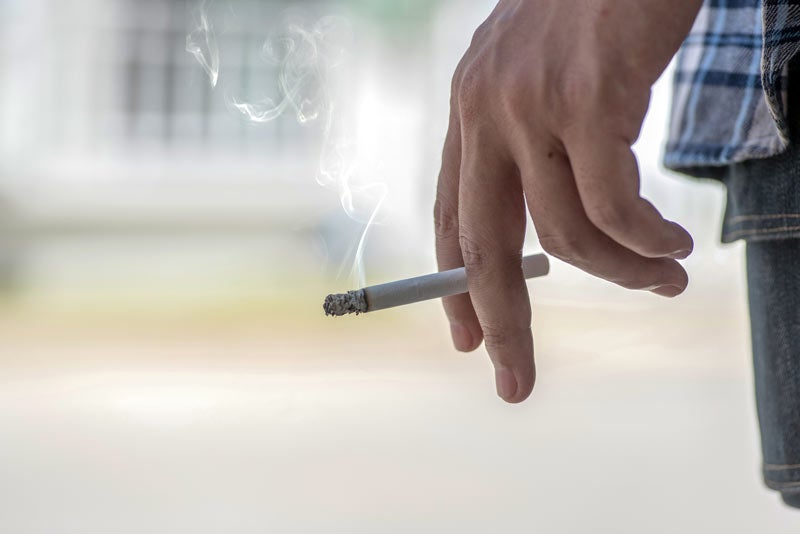
How are tobacco and cancer linked?
Using tobacco makes it more likely that you will get cancer. This includes lung, mouth, throat, bladder, and other cancers. In fact, 1 out of 5 people with cancer in the U.S. got it from smoking.
All tobacco products, such as cigarettes, cigars, pipe tobacco, chewing tobacco, and snuff, have harmful contents. These include:
-
Poisons (toxins), like cyanide, lead, and arsenic.
-
At least 70 chemicals in tobacco smoke that can cause cancer (these are called carcinogens).
-
Nicotine, which is addictive.
-
Chemicals called tobacco-specific nitrosamines (TSNAs), which cause cancer.
Each tobacco product is linked to an increased risk for certain kinds of cancer:
|
Tobacco product |
Risks |
|
Cigarettes |
Cigarettes are the most common way people use tobacco. They are linked to nearly 1 in 5 deaths in the U.S. And they cause about 80% to 90% of all lung cancer deaths in the U.S., according to the American Cancer Society and American Lung Association. Tobacco smoke contains more than 7,000 chemicals. Smokers are also at a higher risk for cancer in other parts of their body than nonsmokers. These include their:
Smoking is also linked to a type of blood cancer called acute myeloid leukemia. |
|
Cigars and pipes |
Some people think cigars and pipes are safer forms of tobacco. But even without breathing in the smoke, they can still increase risk for cancer. This includes cancer in the:
Pipe smokers also have a higher risk for lip cancer. Cigars take longer to burn and usually have more tobacco than cigarettes. So this can increase the exposure to secondhand smoke, too. |
|
Chewing tobacco and snuff |
These are types of smokeless tobacco. They are placed between the cheek and gum. The nicotine is absorbed through the mouth. Even though it's not smoked, this type of tobacco still has harmful contents. More than 25 cancer-causing chemicals have been found in it. The worst ones are TSNAs. Chewing tobacco can be in the form of a leaf or a plug. Snuff is a powder that often comes in a can. They can cause cancer in the:
Cancer often starts where the tobacco sits in the mouth. It can begin as a gray-white patch in the mouth or throat. This is called leukoplakia. Chewing tobacco is also linked to cancer of the esophagus and pancreas. |
Are cigars safer than cigarettes?
No, they are not. Many cigar smokers don't breathe in the smoke, but they still have a high risk of cancer. And cigar smoke contains cancer-causing agents, much like cigarette smoke. In fact:
-
Cigar smokers are more likely than nonsmokers to get cancers of the mouth, throat, voice box, and esophagus.
-
One large cigar can have as much nicotine as a whole pack of cigarettes.
-
Cigar smokers may spend an hour or more smoking one cigar.
-
Secondhand smoke from cigars, like cigarette smoke, has toxins and cancer-causing agents.
How can I stop using tobacco?
The American Cancer Society, American Lung Association, and National Comprehensive Cancer Network offer the following tips if you are trying to quit using tobacco products:
-
Think about why you want to quit.
-
Pick a quit day within the next month.
-
Ask family, friends, and coworkers to support you.
-
Do something active every day to help with stress and improve your health.
-
Get plenty of rest and eat a well-balanced diet.
-
Join a stop-smoking program or other support group.
-
Talk with your doctor about medicines that may help.
-
For help quitting tobacco, go to:
-
https://www.cdc.gov/tobacco/about/how-to-quit.html, 800-QUIT-NOW (800-784-8669)
-
https://smokefree.gov, 877-44U-QUIT (877-448-7848)
-
www.lung.org/stop-smoking, 800-LUNGUSA (800-586-4872)
-
https://www.nccn.org/patients/guidelines/content/PDF/quitting-smoking-patient.pdf, 215-690-0300
-
Featured in



