Definition

Your Child's Teeth

Choose a preferred language

A child's first teeth are called baby or primary (deciduous) teeth. Primary teeth are present deep in the gums at birth. These teeth start to come in between 4 and 18 months of age. In most children, all 20 baby teeth are in place by age 3. Taking good care of them helps the adult teeth develop correctly.

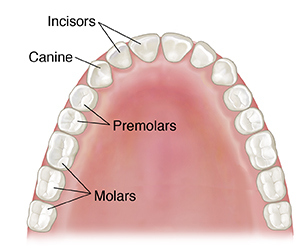
At age 6 or 7, baby teeth begin to fall out. They are replaced by adult (permanent) teeth. Most adult teeth are in place by the time a child is in their early teens. Permanent teeth are the ones a child will have for the rest of their life.
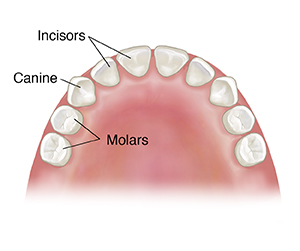
Top view of child's upper jaw showing primary teeth.Baby teeth

Top view of child's upper jaw showing permanent teeth.Adult teeth

Featured in

Online Medical Reviewer: Jessica Gotwals RN BSN MPH

Online Medical Reviewer: Michael Kapner MD

Online Medical Reviewer: Tennille Dozier RN BSN RDMS

Date Last Reviewed: 06/01/2025

© 2000-2026 The StayWell Company, LLC. All rights reserved. This information is not intended as a substitute for professional medical care. Always follow your healthcare professional's instructions.



Make an Appointment

Make an Appointment

Find a Doctor

Find a Doctor

Find a Location

Find a Location
Related Articles
Read article
Dental Care
Hand-Foot-and-Mouth Disease in Children

Hand-foot-and-mouth disease is an illness caused by a virus. It causes a rash on the palms of the hands and soles of the feet. It can also occur in the diaper area, and on the legs and arms.

Read article
Dental Care
Dental Health for Children: Overview

Generally, dental exams and cleanings are recommended every 6 months for children. Encourage good oral hygiene at home by helping your child brush their own teeth.

Read article
Dental Care
Dental Infection (Child)

An abscess is an area of fluid (pus) that happens where there is an infection. A dental abscess is caused by bacteria inside a tooth. Read on to learn more.

Read article
Dental Care
Canker Sore (Child)

A canker sore is a painful sore on the lining of the mouth. Canker sores are not cold sores or fever blisters. Learn about the causes, symptoms, treatment, and more.
