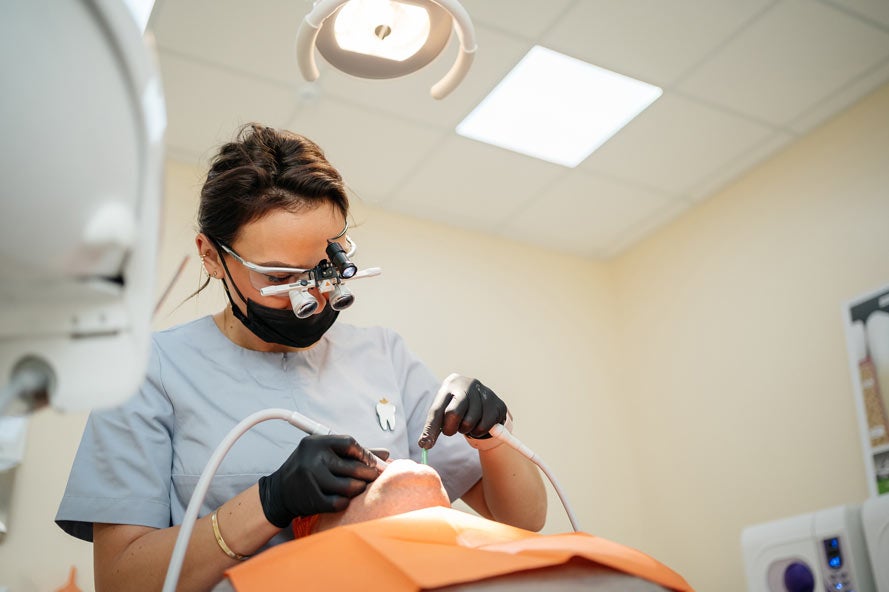
What are dental sealants?
Dental sealants are thin, plastic coatings that bond to the chewing surfaces of the back teeth (molars and premolars). Sealants help prevent tooth decay (cavities). They work very well on the back teeth. These teeth contain more hard-to-reach pits and grooves where food debris and bacteria can settle.
How well do dental sealants work?
Sealants act as a physical barrier to bacteria and acid from leftover food that can lead to decay. In most cases, they reduce the risk for decay by nearly 80% for 2 years. And they continue to protect against 50% of cavities for up to 4 years. Studies also show that sealants may be used over areas of early decay to prevent further damage to the teeth. This action seals off nutrients to the bacteria that causes the cavity. A sealant doesn't work when all or part of the bond between the tooth and the sealant is broken. Sealants will often last several years before they need to be reapplied.
Who are likely candidates for dental sealants?
Adults can benefit from sealants. But they are most helpful for children. That's because children's new adult (permanent) teeth are most at risk for cavities. The U.S. Centers for Disease Control and Prevention (CDC) recommends that sealants be used as part of a child's total preventive dental care. A complete preventive dental program includes:
-
Sealants.
-
Fluoride.
-
Plaque removal.
-
Good home care.
-
Careful food choices.
-
Regular dental care.
Sealants also help keep teeth healthy. Each time a tooth is filled due to tooth decay, more tooth structure is lost. Fillings last an average of 6 to 8 years. After that time, they need to be replaced. So sealants often save time and money. They also reduce the discomfort of dental treatment procedures and keep the teeth healthy.
How is the procedure done?
The procedure starts with cleaning the surface of the tooth and rinsing the surface to remove all traces of the cleaning agent. Then the tooth is dried. An acidic solution or gel is put on the tooth's surface, including the pits and grooves. This is done to make the surface rough. After a few seconds, the solution is completely rinsed away with water and the site is dried. The liquid sealant is then applied and hardened with a special blue light (curing light).
With correct oral hygiene, sealants may last several years. If sealants are chipped or lost, they can easily be redone.
Online Medical Reviewer: Marianne Fraser MSN RN
Online Medical Reviewer: Rita Sather RN
Online Medical Reviewer: Stacey Wojcik MBA BSN RN
Date Last Reviewed: 09/01/2025
© 2000-2026 The StayWell Company, LLC. All rights reserved. This information is not intended as a substitute for professional medical care. Always follow your healthcare professional's instructions.


