Your dentist has advised dental implants for your missing teeth. A dental implant is an artificial tooth root. Surgery is used to place the implants in your jawbone. Most implant surgeries are done in a dental office. Be sure to discuss any questions with your dentist before the procedure. Read on to learn more about what to expect with surgery.
Getting ready for surgery
To prepare for surgery, follow your surgeon’s instructions. Also:
-
Tell your healthcare provider if you’re taking any medicines. This includes any prescription or over-the counter medicines, vitamins, herbs, or supplements.
-
Wear comfortable clothes to the office.
-
Take antibiotics as prescribed.
-
If you will be sedated or asleep (under general anesthesia) during surgery, arrange for an adult to give you a ride home.
-
Follow any directions you are given for not eating or drinking before surgery.
During surgery
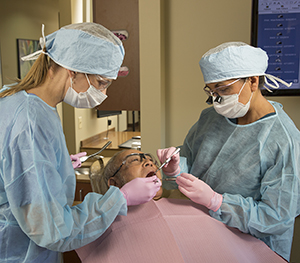
The length of surgery depends on how many implants are placed. If you’re awake, you may hear sounds or feel vibrations. But you shouldn’t feel any pain.
-
When you arrive, you may be asked to rinse your mouth with an antiseptic.
-
You may also be given medicine to help you relax or to make you sleepy.
-
Right before surgery, the jaw is numbed.
-
The surgeon will make an incision in the gum to expose the jawbone. This allows the surgeon to prepare the bone.
-
To prepare the bone, a precise hole is slowly and gently drilled into the jawbone. The size of the hole depends on the size of the implant.
-
The implant is twisted or gently tapped into position.
-
Then the incision is closed with stitches.
-
In some cases, abutments are placed at the same time as implants. Abutments are connecting pieces that join artificial teeth (prostheses) to the implants. Healing abutments allows the gum to form around the implant as it heals.
Risks and possible complications
The risks and complications of implant surgery include:
-
Bleeding.
-
Infection.
-
Excessive pain.
-
Failure of the implant (jawbone doesn’t fuse to the implant).
-
Injury to nearby teeth or sinus.
-
Injury to nearby nerves and muscles.
Featured in
Online Medical Reviewer: Jessica Gotwals RN BSN MPH
Online Medical Reviewer: Michael Kapner MD
Online Medical Reviewer: Rita Sather RN
Date Last Reviewed: 02/01/2025
© 2000-2026 The StayWell Company, LLC. All rights reserved. This information is not intended as a substitute for professional medical care. Always follow your healthcare professional's instructions.


