A fixed bridge is one or more replacement teeth attached to the natural teeth next to them. Once a fixed bridge is in place, it is not removed. A bridge can be made of gold, alloy, porcelain, or a combination of these materials. Your dentist will advise the best material for your mouth. There are two main types of bridges:
-
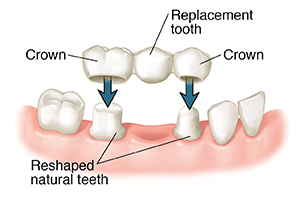
Conventional bridge. This has replacement teeth that are attached to crowns. The crowns are cemented over the natural teeth on either side of the space to be filled.
-
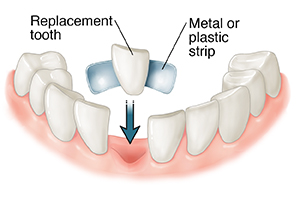
Resin-bonded bridge. This has replacement teeth that are attached to the back of nearby natural teeth using a metal or plastic strip and cement. This type of bridge is also called a Maryland bridge.
What happens after tooth loss?
Spaces left by missing teeth affect the rest of your teeth. These gaps can cause chewing problems. If even one tooth is missing, other teeth may slowly shift out of place. This changes the way your teeth fit together (your bite). A poor bite may make your jaw sore. Your teeth may become harder to clean. This may lead to tooth decay and gum disease. Shifting of teeth after tooth loss may change your smile. A bridge replaces one or more missing teeth and makes it easier for you to chew, improves your appearance, and keeps your teeth, gums, and jaws healthy.
The procedure
It will usually take two or more visits to prepare and fit your bridge.
Preparing your teeth
For a conventional bridge, the teeth on either side of the space to be filled must be reshaped to hold crowns that support the bridge. A temporary bridge will likely be put in place first. For a resin-bonded bridge, a small amount of reshaping is needed. For either bridge, molds (impressions) of your teeth are taken and used to make your bridge. This process takes about 2 weeks.
Fitting your bridge
When it's ready, your dentist places the bridge on your teeth and adjusts it until it fits and feels right. The bridge is then cemented or bonded into place. If you have any problems over the next few days, call your dentist.
Online Medical Reviewer: L Renee Watson MSN RN
Online Medical Reviewer: Michael Kapner MD
Online Medical Reviewer: Rita Sather RN
Date Last Reviewed: 09/01/2025
© 2000-2026 The StayWell Company, LLC. All rights reserved. This information is not intended as a substitute for professional medical care. Always follow your healthcare professional's instructions.


