Dismiss Modal

Management

Bolus Tube Feeding

Choose a preferred language

People with feeding tubes who can tolerate a normal amount of food at one time can be fed by bolus feeding. Feedings are most often given every 4 to 6 hours during waking hours. You’ll be told how often to give the feedings and how much water to give between feedings. To start, wash your hands. Then open and use only the prescribed amount of liquid food (formula). Do not give unapproved food or liquid into the tube. They can clog or cause breakdown of the tube.

Bolus feeding is given by syringe into gastric (stomach) feeding tubes. If you have a small intestine (jejunal) feeding tube, you should not bolus feed. Always remember to give feeding while you are at a 30-degree angle upright or greater. Do not give when you are lying flat, because it can increase your risk of aspiration. (Aspiration means that the food comes back up from your stomach into your throat and windpipe.)

The syringe connects with the feeding tube by twisting together. This way, the food won't leak out when you push the syringe. You will also be told to flush your tube with water before and after feedings to prevent clogging. Follow your care team's instructions.


Twist-type safety syringe and feeding tube

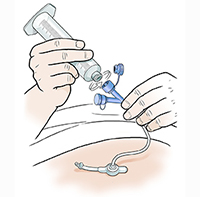
Hands connecting twist-on syringe to port on feeding tube.

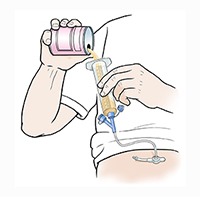
Hands pouring liquid food from can into syringe attached to feeding tube port.

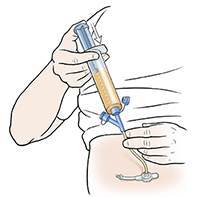
Hand pressing plunger on syringe filled with liquid food attached to feeding tube port.

Step 1. Twist the syringe tip onto the feeding tube.

  • Pull the plunger out of the syringe.

  • Remove the feeding tube's port cap.

  • Twist the syringe tip onto the feeding tube's safety port.

Step 2. Fill the syringe.

  • Pour the formula into the syringe.

  • Fill only to the top line on the syringe.

Step 3. Give the feeding.

  • Depending on your care team's instructions, put the plunger back into the syringe, then push down slowly on the plunger.

    OR

  • Hold the syringe straight up and let the formula run through the tube by gravity.


Repeat steps 2 and 3

  • Repeat steps 2 and 3 until you’ve given the prescribed amount of formula.

  • Unscrew the syringe. Replace the tube's port cap.

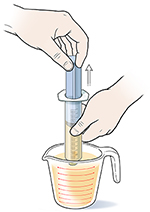
You can also fill the syringe from a measuring cup.

  • Leave the plunger in the syringe.

  • Pour the formula into the measuring cup.

  • Put the syringe tip into the cup. Pull up the plunger. 

  • Then twist the syringe tip onto the feeding tube's safety port.

Closeup of hands drawing liquid food into syringe from measuring cup.

© 2000-2025 The StayWell Company, LLC. All rights reserved. This information is not intended as a substitute for professional medical care. Always follow your healthcare professional's instructions.

Make an Appointment

Make an Appointment

Find a Doctor

Find a Doctor

Find a Location

Find a Location
Related Articles
Read article
Digestive Health
Ileostomy: Dealing with a Food Blockage

After an ileostomy, it may be harder to digest foods that are high in fiber. Eaten in large amounts, these foods can clump together and cause a blockage. Learn about the signs of a blockage and what to do if you have one.

Read article
Digestive Health
Soft Diet

Your healthcare provider has prescribed a soft diet. This means eating foods that are soft, low in fiber, and easy to digest. Here are some general guidelines to get you started.

Read article
Digestive Health
Colostomy: Caring for Your Stoma

You need to take care of your stoma and the skin around it (peristomal skin). This helps prevent skin problems and odor.

Read article
Digestive Health
Colostomy: Managing Your Nutrition

You don't have to eat a special diet just because you've had a colostomy. But you may need to be more aware of foods that cause gas or odor and foods that make your stool too runny or too hard.