Dismiss Modal

Treatment

Types of Colon Resections

Choose a preferred language

In a colon resection, part of the colon is taken out (resected) during surgery. The most common types of colorectal resection are listed below. Your surgeon will explain the one that is right for you.
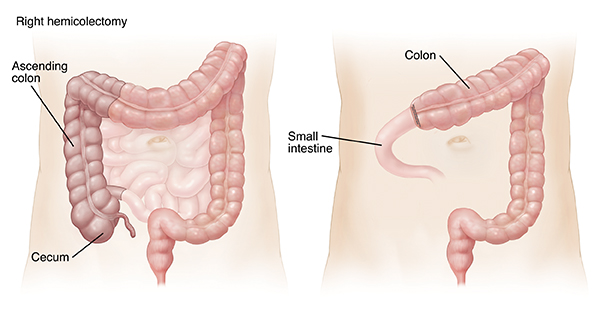
Outline of adult abdomen showing large and small intestines. Shaded area on left image shows right hemicolectomy. Outline of adult abdomen showing colon and small intestine connected after right hemicolectomy.

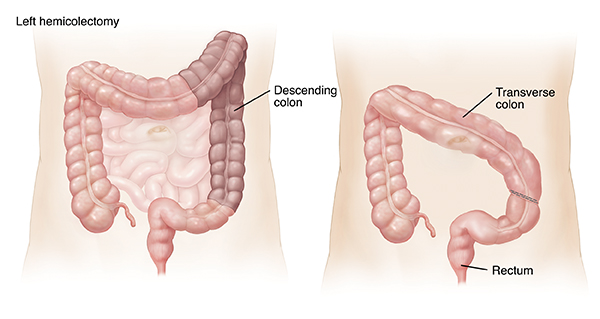
Outline of adult abdomen showing large and small intestines. Shaded area on left image shows left hemicolectomy. Outline of abdomen showing transverse colon attached to sigmoid colon after left hemicolectomy.

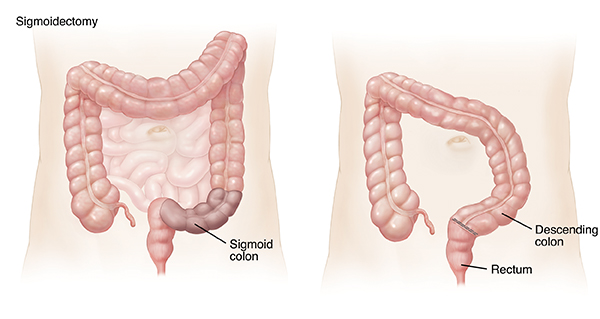
Outline of adult abdomen showing large and small intestines. Shaded area on sigmoid colon shows sigmoidectomy. Outline of adult abdomen showing descending colon attached to rectum after sigmoidectomy.

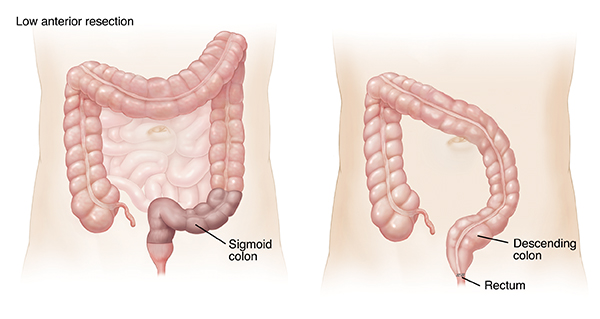
Outline of adult abdomen showing large and small intestines. Shaded area on sigmoid colon and rectum shows low anterior resection. Outline of adult abdomen showing descending colon attached to rectum after low anterior resection.

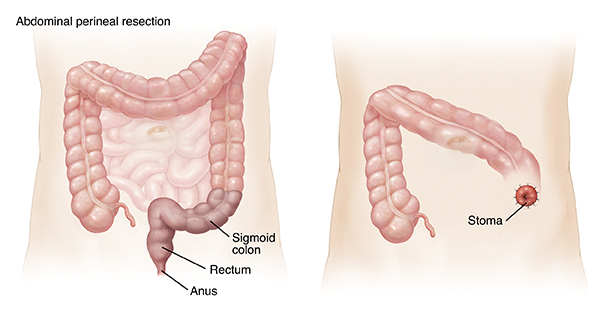
Outline of adult abdomen showing large and small intestines. Shaded area on sigmoid colon, rectum, and anus shows abdominal perineal resection. Outline of abdomen showing stoma after abdominal perineal resection.


Colostomy

After surgery, the colon and rectum may need to be kept clear of stool while they heal. In other cases, the rectum has been taken out or it can’t be reconnected to the rest of the colon. In either case, you need a colostomy. This makes a new opening (stoma) in the belly (abdomen) so waste can leave the body. You may need the new opening for a short time, or permanently. If you had a colostomy during your surgery, your health care providers will help you learn how to care for it.

© 2000-2026 The StayWell Company, LLC. All rights reserved. This information is not intended as a substitute for professional medical care. Always follow your healthcare professional's instructions.



Make an Appointment

Make an Appointment

Find a Doctor

Find a Doctor

Find a Location

Find a Location
Related Articles
Read article
Digestive Health
Having Bowel Surgery: Proctocolectomy with Permanent Ileostomy

This surgery is done to treat diseases of the digestive tract. It removes all of the large intestine. When healed, waste passes from the small intestine through an opening (stoma) in the belly wall and into a pouch outside of the body.

Read article
Digestive Health
Having Rectal Surgery

Read on for details about rectal surgery, including what to expect before, during, and after the procedure.

Read article
Digestive Health
What Is a Colostomy?

During a colostomy part of the colon (large intestine) is removed or disconnected. If the large intestine was diseased, it may be removed. If it was injured, it may be disconnected for a short time while it heals, then reconnected after a certain period of time.

Read article
Digestive Health
Having Bowel Surgery: Continent Ileostomy

This surgery is done to treat diseases of the digestive tract. It removes all of the large intestine. During the surgery, an opening (stoma) is made in your belly. When healed, waste collects in a pouch inside your body. It's then drained through a thin tube (catheter).