PEG (percutaneous endoscopic gastrostomy) is a type of procedure. It is done to put a tube in place for feeding when a person has trouble eating. A feeding tube may be used if:
-
You can’t swallow food safely.
-
You have a blockage in your swallowing tube (esophagus) or stomach.
-
You can’t take enough food by mouth.
The path of digestion
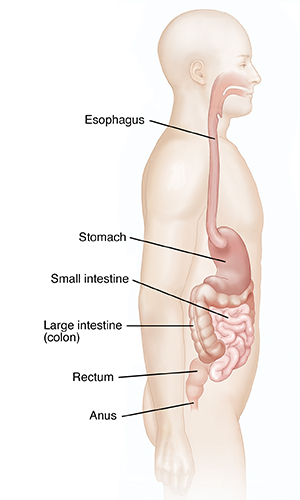
When you eat, you chew your food into small pieces and swallow. The food moves down your esophagus and into your stomach. From there, it goes into your small intestine and then into your large intestine. Solid waste (stool) is stored in your rectum. It is then passed out through the anus.
A feeding tube lets food bypass the mouth and esophagus. It goes right into your stomach or small intestine.
Digestion works the same with a feeding tube as it does when you take food by mouth. You get the same nutrition by tube feeding as you would by eating.
How a feeding tube is placed
You will have one of these:
-
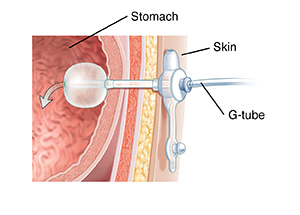
Tube in the stomach. A G-tube is placed in the stomach. The G stands for gastrostomy. (This is an opening into the stomach.) The tube may also be called a PEG tube.
-
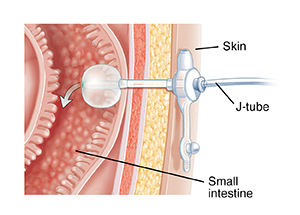
Tube in the small intestine. In some cases, the tube may be placed in the belly and passed through to a section of the small intestine. This section is called the jejunum. The tube may be called a J-tube or PEJ tube. The J stands for jejunum.
Your doctor places a feeding tube with the aid of a tool called an endoscope. This is a long, flexible, lighted tube that lets your provider see inside your stomach. It is passed through your mouth and down to your stomach.
Next, they make a small cut through your skin and into your stomach. They insert the feeding tube through this small cut. They do this while watching through the endoscope. A small balloon or cap holds the tube in place. Your doctor then places a small bandage over the cut.
Talk with your care team
If you have any questions or concerns about the feeding tube or its care, talk with your provider. Tell them if you want a partner or caregiver to be instructed about the feeding tube.
Online Medical Reviewer: Daphne Pierce-Smith RN MSN
Online Medical Reviewer: Lalitha Kadali Researcher
Online Medical Reviewer: Melinda Murray Ratini DO
Date Last Reviewed: 11/01/2024
© 2000-2026 The StayWell Company, LLC. All rights reserved. This information is not intended as a substitute for professional medical care. Always follow your healthcare professional's instructions.


