Occasional nasal stuffiness and sneezing are common in newborn babies. Hiccups are also common.
Stuffy noses
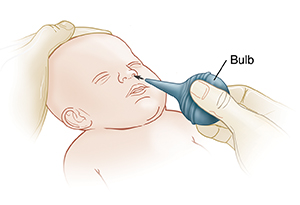
Babies can only breathe through their noses (not their mouths). So, when your baby’s nose is stuffed up with mucus, it’s much harder for them to breathe. When this happens, use saline nose drops or spray (available without a prescription) to loosen the mucus. You may also use a bulb syringe to clear out your baby’s nose.
Using a bulb syringe
-
Squeeze the bulb.
-
Put only the tip of the syringe in the baby’s nose. (Don’t push the syringe up the baby’s nose.)
-
Release the bulb. This sucks mucus out of the baby’s nose and into the syringe.
-
DON’T put the syringe in the baby’s nose before squeezing the bulb. Doing so will blow mucus farther up the nose.
-
After use, clean the syringe well with hot water and soap. While the tip of the syringe is in the soapy water, squeeze and release the bulb. This will fill the syringe with hot, soapy water. Then remove the tip from the water and squeeze the bulb again to empty the syringe. Repeat this process with clean, hot water to clear the soap out of the syringe.
-
If you have questions about using a bulb syringe, ask your baby’s doctor.
Sneezes
Babies sneeze to clear germs and particles out of the nose. This is a natural defense against illness. Sneezing every now and then is normal. It doesn’t necessarily mean the baby has a cold.
Hiccups
Hiccups are normal and babies don't seem bothered by them. Breastfeeding or sucking on a pacifier may help get rid of the hiccups. If not, don’t worry. They’ll stop on their own.
When to contact your child's doctor
An occasional sneeze or stuffy nose usually isn’t a sign of a problem. But if these happen often, they could mean the baby has a cold or other health problem. Call your baby's doctor if your baby:
-
Coughs.
-
Sneezes often.
-
Is breathing faster than normal.
-
Doesn’t eat as much as normal.
-
Is more sleepy than usual or less energetic than normal.
-
Has a fever of 100.4°F (38°C) or higher, or as directed by the doctor.
Featured in
Online Medical Reviewer: Stacey Wojcik MBA BSN RN
Online Medical Reviewer: Tracy C. Garrett RNC-NIC BSN
Date Last Reviewed: 06/01/2025
© 2000-2026 The StayWell Company, LLC. All rights reserved. This information is not intended as a substitute for professional medical care. Always follow your healthcare professional's instructions.


