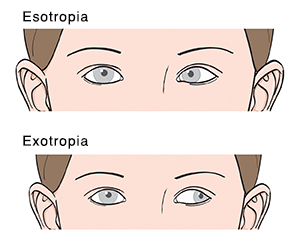
When your child has strabismus, their eyes don’t line up (align) in the same direction. One eye may turn in, out, up, or down, while the other eye looks straight ahead. When an eye turns in, the child has esotropia (cross-eyed). When the eye turns out, the child has exotropia (wall-eyed). When the eyes aren`t aligned, pictures sent to the brain from each eye are too different to be blended into 1 image. If strabismus isn`t treated, the brain may start ignoring the eye that turns in a different direction. This can lead to a vision problem called amblyopia, or lazy eye.
What causes strabismus?
Strabismus has 2 main causes:
-
Focusing problems, such as being very farsighted, that cause an eye to turn in when trying to focus.
-
Eye muscles that can't keep the eyes aligned.
Treatments for strabismus
Your child's healthcare provider may refer your child to an eye specialist (pediatric ophthalmologist). This eye care provider will do a full evaluation of your child's vision. Strabismus is treated by correcting the problem that's making your child's eyes turn. This can align the eyes and may help your child see more clearly. Treating strabismus helps prevent other problems from occurring. If your child also has amblyopia, treatment for that will be needed as well.
Treatments for strabismus may include:
-
Glasses. These may correct focusing problems so your child can see more clearly. Glasses can also keep the eyes aligned by helping a very farsighted eye to focus without turning in. Some children prefer contact lenses to glasses. Your child's eye care provider can tell you if this is an choice.
-
Prism lenses. These special lenses are thicker on 1 side than the other. The prisms alter the light entering the eye and reduce how much turning the eye must do to view objects.
-
Eye muscle surgery. This is needed in some cases to align the eyes. Post-surgery vision therapy is often recommended to improve eye coordination and to keep the eyes from becoming misaligned again.
-
Vision therapy. Vision therapy trains the eyes and brain to work together more effectively. These eye exercises can help problems with eye movement, eye focusing, and eye teaming, and reinforce the eye-brain connection.
Treatment goals for strabismus
-
Correct the problem that's causing the eyes to turn out of alignment
-
Align the eyes
-
Improve sight in both eyes as much as possible
-
Make the eyes work together at the same time to focus on the same visual target together.
-
Treat double vision
All siblings of a strabismic child should be screened at an early age for strabismus.



