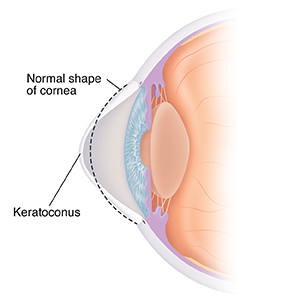
Keratoconus is an eye disorder where your cornea thins slowly over time. The cornea also bulges out to form a cone-like shape. It's not a common condition. It happens more often in young adults in their teens and 20s.
How to say it
kayr-uh-toh-KOH-nuhs
Understanding keratoconus
The cornea is the eye’s outermost layer. It's a clear layer on the front of your eye. It helps protect your eye from dirt and germs. It also helps control the entry of light into your eye. With keratoconus, the lower and center parts of your cornea get thin. In rare cases, the cornea may also swell and become scarred. These changes can cause eyesight problems, such as nearsightedness and astigmatism.
There are different types of keratoconus. The types are based on which part of the cornea is thin, and what shape it takes. The types include nipple, oval, keratoglobus, and D-shaped keratoconus.
What causes keratoconus?
Healthcare providers don't know what causes keratoconus. Some cases may be partly because of genes. Some health conditions are linked to keratoconus and may lead to the disorder. These include:
-
Eye injury from excessive eye rubbing or contact lens use
-
Retinitis pigmentosa
-
Retinopathy of prematurity
-
Vernal keratoconjunctivitis
-
Leber congenital amaurosis
-
Ehler-Danlos syndrome
-
Down syndrome
-
Osteogenesis imperfecta
Certain factors may increase the risk for the condition. Using contact lenses that don’t fit well may raise your risk. Chronic eye rubbing because of eye irritation may raise your risk.
Symptoms of keratoconus
In early stages, symptoms may include eye redness or swelling, blurry vision, or increased sensitivity to light. During later stages, keratoconus causes nearsighted vision (myopia). This means you have trouble seeing things that are far away. It also causes astigmatism. This is a problem with your eye forming a focused image on your retina. Together these lead to blurry vision.
Keratoconus usually causes symptoms in both eyes. One eye may show symptoms before the other. One eye may be affected more than the other eye. Symptoms often start during puberty and get worse until the fourth decade of life. You may not know you have the condition unless your eye healthcare provider does special tests. Later, your vision may get much worse. Your eye healthcare provider may check you for keratoconus if your vision is getting much worse than expected.
Diagnosing keratoconus
Your eye healthcare provider will ask about your past health and give you an eye exam. They will also test the sharpness of your eyesight. You may need to have your eyes dilated for part of the exam. Your eye healthcare provider may use a device to measure the curve of your cornea. Keratoconus may not be found in its early stages unless your eye healthcare provider is looking for signs of it. An imaging test called corneal topography may help your eye healthcare provider make the diagnosis. This test shows changes in the shape of the cornea.
Online Medical Reviewer: Chris Haupert MD
Online Medical Reviewer: Jessica Gotwals RN BSN MPH
Online Medical Reviewer: Whitney Seltman MD
Date Last Reviewed: 12/01/2022
© 2000-2026 The StayWell Company, LLC. All rights reserved. This information is not intended as a substitute for professional medical care. Always follow your healthcare professional's instructions.


