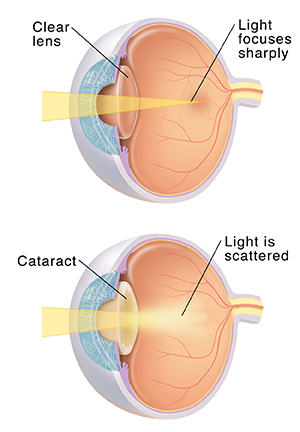
The lens in the eye focuses light so the eye sees images sharply. Aging is the most common cause of cataracts. With age, the lens slowly becomes cloudy. The cloudy lens is a cataract. A cataract scatters light and makes it hard for the eye to focus. Cataracts usually form in both eyes. But one lens may cloud faster than the other.
The aging of your lens
Your lens may cloud so slowly that you don`t notice any vision changes at first. But as the cataract gets worse, the eye has a harder time focusing. In early stages, glasses may help you see better. As the lens gets more cloudy, your healthcare provider may advise surgery to restore your vision.
A clear lens allows your eye to bring objects sharply into focus.
A mild cataract may slightly blur your vision.
A dense cataract can severely blur your vision.
Online Medical Reviewer: Chris Haupert MD
Online Medical Reviewer: Marianne Fraser MSN RN
Online Medical Reviewer: Raymond Kent Turley BSN MSN RN
Date Last Reviewed: 09/01/2025
© 2000-2026 The StayWell Company, LLC. All rights reserved. This information is not intended as a substitute for professional medical care. Always follow your healthcare professional's instructions.


