Dismiss Modal

Types

What Are Flashes and Floaters?

Choose a preferred language

Have you ever seen flashes of light, stars, or streaks that aren’t really there? A few of these flashes are seen by everyone from time to time. Usually you see them in one eye at a time. Flashes are often caused by the gel (vitreous) inside your eye pulling on the retina. The retina is a membrane that lines the inside of your eye.

Floaters look like dark specks, clouds, threads, or spiderwebs moving through your eyesight. Most people see them once in a while. Floaters may be pieces of gel or other material floating inside your eye. They are usually harmless.
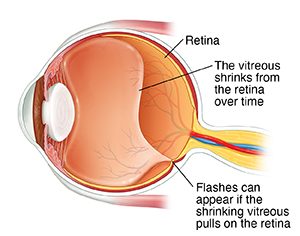
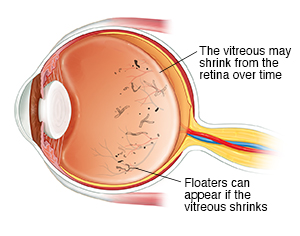
Three-quarter view of cross-sectioned eye showing shrinking vitreous pulling on retina.Three-quarter view of cross-sectioned eye showing shrinking vitreous and floaters.


Who gets flashes?

As you age or if you are nearsighted, you are more likely to see flashes. Nearsightedness is when you have fuzzy distance vision. Sometimes flashes are a sign of other eye problems that should be evaluated and may need care.


Who gets floaters?

The older you get, the more likely you’ll notice floaters. Floaters can also be caused by an eye injury or surgery. People who are very nearsighted may get more floaters. If floaters appear suddenly or greatly increase in number, see your healthcare provider as soon as possible. This may be a sign of an eye problem.


© 2000-2025 The StayWell Company, LLC. All rights reserved. This information is not intended as a substitute for professional medical care. Always follow your healthcare professional's instructions.

Make an Appointment

Make an Appointment

Find a Doctor

Find a Doctor

Find a Location

Find a Location
Related Articles
Read article
Eye Care
Iritis

Iritis is an inflammation of the iris. It can be caused by injury to the eye or disease elsewhere in the body. Symptoms include redness, pain in the eye or brow region, sensitivity to light, and blurred vision.

Read article
Eye Care
Ptosis

Ptosis is when the upper eyelid droops down more than it should. If the ptosis is severe, it may block vision.

Read article
Eye Care
Ectropion

Ectropion is an eyelid that sags or turns outward. It often affects one or both lower eyelids. Ectropion leaves the eye too exposed. The eye can become dry, irritated, and even infected. This can lead to serious problems. In some cases it can lead to loss of eyesight.

Read article
Eye Care
Corneal Ulcer

A corneal ulcer is an open sore on your cornea. It's often caused by an infection.

