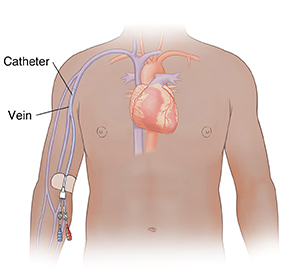
You need a midline catheter for your treatment. A midline catheter is a thin, soft tube that is placed into a vein, usually in the arm. The catheter is then moved through the vein until the tip sits at the level of your armpit and away from the shoulder. A midline catheter is often used when you need to have medicines or fluids for more than 1 or 2 days. When you no longer need it, your doctor will take it out. Your skin will heal. This sheet tells you more about a midline catheter and how a doctor places it in your body.
Why do I need a midline catheter?
A midline catheter takes the place of a standard I.V. (intravenous) line. A standard I.V. needs to be changed every few days. A midline catheter can stay in place longer. So you may have fewer needle sticks during your treatment. There is less damage to the small veins where an I.V. would be placed. Your doctor can give you more details about why you need a midline catheter for your treatment.
Getting a midline catheter
In most cases, a midline catheter is placed into a vein in your upper arm. You may have this done in a special procedure unit, the X-ray department, or at your bedside in the hospital. Your doctor can tell you what to expect. In general, during placement:
-
You may get a shot of a local anesthetic to numb the area.
-
A sterile sheet will be placed over your arm. Only the spot where the catheter will be placed is exposed.
-
The area where the catheter will be placed is cleaned with an antiseptic solution.
-
The catheter is gently passed into the vein. It's moved along until the tip reaches the armpit area.
-
The other end of the catheter that sticks out a few inches from your skin is held in place with a device or tape.
-
The doctor will flush the catheter with saline solution to make sure it's clear.
-
A dressing will be placed over the area where the catheter leaves the skin. Follow your doctor's specific care instructions on how to change the dressing and when to flush the catheter and change the cap.
Risks and possible complications
As with any procedure, getting a midline catheter has certain risks. These may include:
-
Infection.
-
Bleeding problems.
-
Swelling of the arm where it's inserted.
-
Injury to the vein.
-
Inflammation of the vein (phlebitis).
-
Clots or air bubbles in the bloodstream.
-
Blockage of the blood vessel where the catheter is placed.
-
Clots in the vein could travel to the lung.
-
Nerve injury.
-
Accidental insertion into an artery instead of a vein.
-
Catheter movement from its correct position.
Always talk with your doctor about what the risks may be for you.
Date Last Reviewed: 09/01/2025
© 2000-2026 The StayWell Company, LLC. All rights reserved. This information is not intended as a substitute for professional medical care. Always follow your healthcare professional's instructions.


