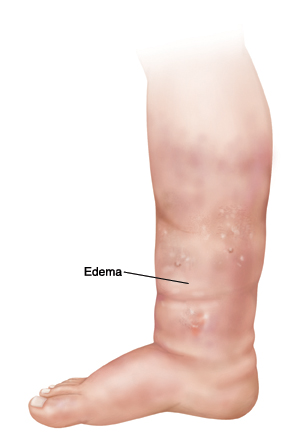
Swelling of the feet, ankles, and legs is called edema. It's caused by extra fluid that has collected in the tissues. Extra fluid in the body settles in the lowest part because of gravity. This is why the legs and feet are most affected.
Some of the causes for edema include:
-
Disease of the heart, such as congestive heart failure.
-
Standing or sitting for long periods of time.
-
Infection of the feet or legs.
-
Blood pooling in the veins of your legs (venous insufficiency) when the veins have less elasticity.
-
Dilated veins in your lower leg (varicose veins).
-
Poor drainage of the lymphatic system.
-
Some medicines, including some hormones such as birth control pills, some blood pressure medicines such as calcium channel blockers, steroids, and some antidepressants such as MAO inhibitors and tricyclics.
-
Menstrual periods that cause you to retain fluids.
-
Many types of kidney disease.
-
Liver failure or cirrhosis.
-
Pregnancy, in which some swelling is normal, but a sudden increase in leg swelling or weight gain can be a sign of a dangerous complication of pregnancy called eclampsia.
-
Poor nutrition.
-
Thyroid disease.
Treatment will depend on what is causing the swelling in your legs. Your health care provider may prescribe water pills (diuretics) to get rid of the extra fluid.
Home care
Follow these guidelines when caring for yourself at home:
-
Keep your legs up while lying or sitting.
-
If infection, injury, or recent surgery is causing the swelling, stay off your legs as much as possible until symptoms get better.
-
If your health care provider says that your leg swelling is caused by venous insufficiency or varicose veins, don't sit or stand in one place for long periods of time. Take breaks and walk about every few hours. Brisk walking is a good exercise. It helps circulate the blood that has collected in your leg. Talk with your provider about using support stockings to stop daytime leg swelling.
-
If your provider says that heart disease is causing your leg swelling, follow a low-salt diet to stop extra fluid from staying in your body. You may also need medicine.
Follow-up care
Follow up with your health care provider as advised.
When to get medical advice
Contact your health care provider right away if any of these occur:
-
Swelling in both legs or ankles that gets worse
-
Belly (abdominal) swelling
-
Redness, warmth, or swelling in one leg
-
Fever of 100.4ºF (38ºC) or higher, or as advised by your provider
-
Yellow color to your skin or eyes
-
Rapid, unexplained weight gain
-
Having to sleep upright or use more pillows
Call 911
Call
-
New or worsening shortness of breath.
-
Chest pain.
Online Medical Reviewer: Stacey Wojcik MBA BSN RN
Online Medical Reviewer: Steven Kang MD
Date Last Reviewed: 04/01/2025
© 2000-2026 The StayWell Company, LLC. All rights reserved. This information is not intended as a substitute for professional medical care. Always follow your healthcare professional's instructions.


