Before hemodialysis can be done, a way for blood to leave and return to your body (an access) is needed. During hemodialysis, needles placed into the access carry blood to and from the dialyzer. A hemodialysis access is often made in your arm. The two main types of access are an arteriovenous fistula (AV fistula) and an arteriovenous graft (AV graft). An interdisciplinary team, usually composed of experienced nurses, nephrologists, radiologists, and vascular surgeons, works with the patient to determine the best type of access.
Making your access
The hemodialysis access provides a large volume of fast flowing blood. It involves surgery under anesthesia. You may be able to go home the same day. It is made during a short procedure using one of these methods:
-
A fistula is made by linking an artery to a nearby vein. The high pressure and blood flow in the artery are transferred into the vein. They help the vein grow in size and thickness. The enlarged vein (fistula) eventually has high blood flow. It becomes thick enough for needles to be placed safely several times each week during hemodialysis. It may need weeks or months to develop before it's ready to be used. A fistula works better than a graft. It also has fewer long-term problems. It is generally the preferred form of access.
-
A graft (piece of synthetic tube) may be sewn between an artery and a vein. It's often used if a fistula is not possible because of the small size of your veins. Blood flows quickly through the graft from the artery to the vein. A graft is often ready to use in a few weeks. Needles can be placed into the plastic tube to get blood during dialysis.
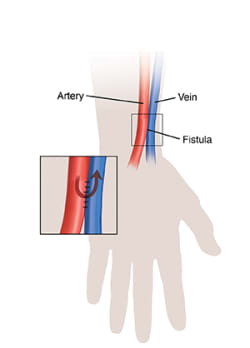
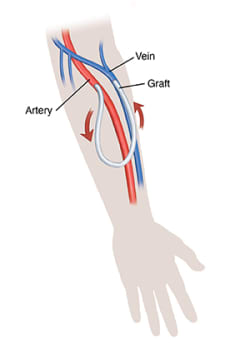
Both types of access may take weeks to months before they can be used. If dialysis is needed right away, a short-term venous catheter is used. A catheter that allows two-way blood flow is placed into a large vein. The dialysis tubing is then connected to the catheter. If both the AV fistula and graft don't work, a more permanent venous catheter is used.
The most common complications for hemodialysis access are:
- Infection
- Clotting
- Decreased blood flow from clotting or other narrowing
Online Medical Reviewer: Raymond Kent Turley BSN MSN RN
Online Medical Reviewer: Rita Sather RN
Online Medical Reviewer: Walead Latif MD
Date Last Reviewed: 09/01/2025
© 2000-2026 The StayWell Company, LLC. All rights reserved. This information is not intended as a substitute for professional medical care. Always follow your healthcare professional's instructions.


