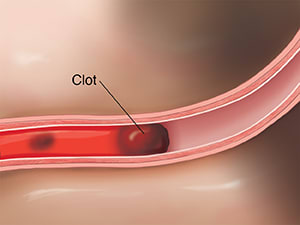
Embolectomy is surgery to remove a blood clot (embolus) from one of your blood vessels. The clot may block the flow of blood to your tissues or organs. Removal of an embolus is often an emergency procedure.
How to say it
ehm-boh-LEHK-toh-mee
Why embolectomy is done
An embolus is a blood clot that has traveled from another part of the body and lodged in a blood vessel. It can block the flow of blood through the vessel. This can cause serious problems, including tissue or organ damage. Removing the clot allows blood to flow freely again.
How embolectomy is done
- An I.V. (intravenous) line will be put in a vein in your arm or hand. You may be given medicine to help you relax (sedation) through the I.V.
- You will be given medicine to help prevent pain during the procedure.
- The doctor will make a cut (incision) through your skin and into the blood vessel with the clot. Or they will make a cut in another blood vessel, so that a tube may be put in to reach the clot. A dye test (angiogram or venogram) may be used to help the doctor see the blood vessel and clot on a video screen.
- The doctor will remove the clot from the blood vessel.
- The doctor may use a thin tube (catheter) to remove any part of the clot that remains. They may put a small mesh tube (stent) in the blood vessel to help hold the vessel open. This is not removed.
- The blood vessel is closed.
- The incision is closed and bandaged.
If you've had a stroke, your doctor may advise a procedure called mechanical thrombectomy. A catheter is put into an artery and guided to the clot in the brain. Doctors often use the femoral artery for this. The doctor puts a clot-removing device through the catheter until it reaches the clot. The doctor removes the clot.
Risks of embolectomy
- Bleeding
- Infection
- Damage to the blood vessel or nearby tissues
- Blood clot fragments dislodging and moving into other parts of the body, including the heart, lungs, or brain
- Compartment syndrome, which is increased pressure in the muscle that cuts down on the flow of blood
- Doctor may not be able to remove the clot
- Doctor may detect other disease in the blood vessel that will need more surgery to fix
- Loss of blood supply to the limb, which could result in an amputation
Author: Michels, Karen
Online Medical Reviewer: Anne Fetterman RN BSN
Online Medical Reviewer: Deepak Sudheendra MD
Online Medical Reviewer: Raymond Kent Turley BSN MSN RN
Date Last Reviewed: 09/01/2025
© 2000-2026 The StayWell Company, LLC. All rights reserved. This information is not intended as a substitute for professional medical care. Always follow your healthcare professional's instructions.


