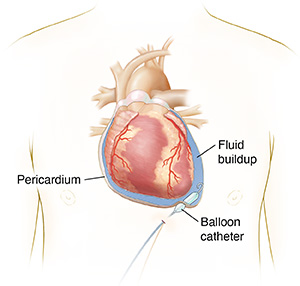
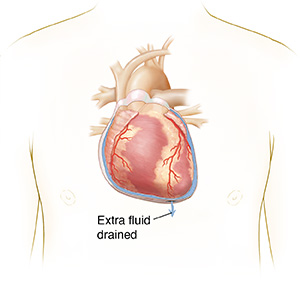
Percutaneous balloon pericardiotomy (PBP) is a procedure to drain extra fluid from the sac around the heart. It’s done with a long, thin tube (catheter) that has a small balloon attached. A small hole is made in the sac. The balloon is inflated to make the hole bigger. Fluid is then drained out through the tube.
How to say it
per-kew-TAYN-ee-uhs
buhl-OON
payr-ee-car-dee-OT-oh-mee
Why might you need percutaneous balloon pericardiotomy?
A fibrous sac surrounds the heart. The sac is called the pericardium. It’s made of two thin layers with a small amount of fluid between them. The fluid helps cushion the two layers as they rub against each other when the heart beats. In some cases, extra fluid can build up between these two layers. This is called pericardial effusion. It can make it hard for the heart to pump normally.
Many types of health conditions can cause extra fluid to build up around the heart. These include:
-
Cancer.
-
Infection.
-
Recent heart attack.
-
Autoimmune disease.
-
Injury.
The fluid buildup can cause shortness of breath and chest pain. Sometimes this can be treated with medicine. In other cases, the fluid is dangerous and needs to be drained right away.
PBP allows this fluid to drain. It can also help prevent future buildup of fluid. PBP is most often used to treat repeated pericardial effusion because of cancer. PBP has fewer risks than surgery. It may not be available at every surgery center.
What happens during percutaneous balloon pericardiotomy?
During PBP, using X-ray guidance, the health care provider puts a needle through the chest wall and into the tissue around the heart. When the needle is inside the pericardium, the provider puts a catheter in its place. The catheter has a small, deflated balloon at its tip. The provider inflates the balloon again and again. This creates a small hole (window) in the pericardium. When the hole is large enough, the catheter and balloon are removed. The provider puts a new catheter in place to finish draining the fluid. When that catheter is removed, any extra fluid that may recur can drain into the larger space around the lungs (pleural cavity). The body then reabsorbs the fluid. After the extra fluid has drained out of the pericardium, your heart function will get better.
What are the risks of percutaneous balloon pericardiotomy?
All procedures have some risks. The risks of PBP can include:
-
Puncturing of the heart, which would require surgical repair.
-
Too much bleeding, which might keep the heart from beating well.
-
Collapsed lung (pneumothorax).
-
Infection.
-
Fluid around the lungs (pleural effusion).
-
Failure of the procedure to drain the fluid correctly.
Your risks will vary depending on your overall health and other factors. Talk with your health care provider about which risks apply most to you.
Online Medical Reviewer: sst
Online Medical Reviewer: Stacey Wojcik MBA BSN RN
Online Medical Reviewer: Steven Kang MD
Date Last Reviewed: 03/01/2025
© 2000-2026 The StayWell Company, LLC. All rights reserved. This information is not intended as a substitute for professional medical care. Always follow your healthcare professional's instructions.


