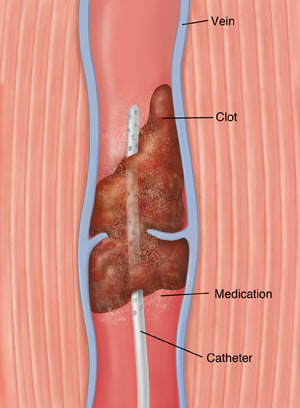
Venous thrombolytic therapy is a procedure used to treat a blood clot in a vein in your arm or leg. If the blood clot blocks blood flow through the vein, symptoms such as pain and swelling can happen. During thrombolytic therapy, clot-busting medicine is used. This helps dissolve the blood clot and restore blood flow through the vein.
Before the treatment
Here is what to expect:
- Thrombolytic therapy is more risky for people with certain health problems. For this reason, you must have a detailed health history taken to see if this treatment is safe for you.
- Be sure to tell your doctor about any health problems you have. Your doctor will also ask if you've had certain problems before, such as a stroke, head injury, or bleeding in your brain.
- Tests will likely be done before the treatment. This includes blood tests and imaging tests.
Tell your doctor about any medicines you are taking. You may need to stop taking all or some of these medicines before the procedure. This includes:
- Medicines that slow down or prevent blood clotting (anticoagulants).
- All prescription medicines.
- Over-the-counter medicines such as aspirin or ibuprofen.
- Illegal drugs.
- Herbs, vitamins, and other supplements.
Tell your doctor if you:
- Are allergic to any medicines.
- Are allergic to X-ray dye (contrast medium).
- Have ever had a reaction to substances used during other tests or procedures.
- Have other health problems, such as diabetes or kidney problems.
- Are pregnant or think you could be.
- Are breastfeeding.
- Have ever had any type of cancer.
Follow any directions you're given for not eating or drinking before the treatment.
Understanding the treatment
This procedure is done in a hospital. It's most often done by a doctor called an interventional radiologist.
Before the treatment begins
Here is what to expect:
- An I.V. (intravenous) line is put into a vein in your arm or hand. This line gives you fluids and medicines.
- You'll be given medicine to keep you free of pain during the treatment. You'll likely receive sedation, which makes you relaxed and sleepy.
During the treatment
Here is what to expect:
- Medicine is injected into your skin to numb the site to be worked on. This is usually in your leg.
- A small needle is used to make a small hole (puncture) through your numbed skin. A thin tube (catheter) is put through the hole.
- The catheter is gently guided through a blood vessel that leads to the vein with the clot. Live X-rays are used to guide the procedure. The X-rays are viewed on a computer screen.
- X-ray dye is injected through the catheter. This makes the blood vessels easy to see on the X-rays.
- Once the catheter reaches the clot, the medicine is slowly injected. In some cases, a mechanical or suction device may be put on the end of the catheter. This also helps to break up the clot.
- The catheter is left in place until the clot dissolves. This usually takes about
12 to 24 hours, but it can take up to72 hours or longer. - X-rays may be taken at different times during this period to see how well the treatment is working.
- The catheter is removed once the treatment is done. Pressure is applied to the insertion site to stop any bleeding. The site is then bandaged.
After the treatment
For small clots, you may be able to go home the same day. For larger or more complex clots, you may need to stay in the hospital for 1 or more days. You'll be watched closely by your health care team during your time in the hospital. When your health care team says you can go home, have an adult family member or friend ready to drive you.
Recovering at home
Once at home, follow all instructions you've been given. Be sure to:
- Drink plenty of water to help flush any extra X-ray dye out of your body.
- Take all medicines as directed.
- Care for the catheter insertion site as directed.
- Check for signs of infection at the insertion site (see below).
- Don't do any heavy lifting or strenuous activities as directed.
- Walk at least a few times a day. Slowly increase your pace and distance as you feel able.
When to contact your doctor
Contact your doctor if you have any of the following:
- Fever of
100.4 ° F (38 ° C) or higher, or as directed by your doctor - Chest pain or trouble breathing
- Signs of infection at the catheter insertion site. This includes increased redness or swelling (inflammation), warmth, more pain, bleeding, or bad-smelling discharge.
- Numbness or tingling in the affected arm or leg
- Pain in the affected arm or leg that won't go away or gets worse
- Affected arm or leg becomes swollen, blue, or cold
Follow-up
You'll have a follow-up visit with your doctor in
Risks and possible complications
These include:
- Bleeding or infection due to problems at the catheter insertion site.
- Bleeding at any site that the clot-busting medicine may have reached. (Note: If bleeding happens in the brain, this could lead to a stroke or death.)
- Parts of the clot may break off and go to places that are hard to reach. If so, you may need more treatments.
- An allergic reaction to the clot-busting medicine.
- Problems due to the X-ray dye, including allergic reaction or kidney damage.
- The risks of anesthesia or any other medicines used during the treatment. (These risks will be discussed with you before the treatment.)
Online Medical Reviewer: Anne Fetterman RN BSN
Online Medical Reviewer: Deepak Sudheendra MD
Online Medical Reviewer: Raymond Kent Turley BSN MSN RN
Date Last Reviewed: 09/01/2022
© 2000-2026 The StayWell Company, LLC. All rights reserved. This information is not intended as a substitute for professional medical care. Always follow your healthcare professional's instructions.


