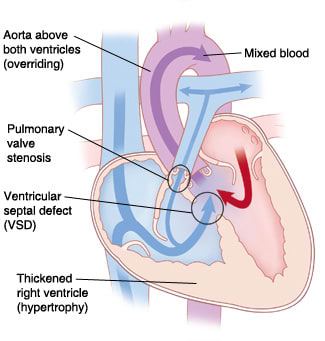
Tetralogy of Fallot (TOF) is a common complex heart defect. TOF is a serious heart condition. But it can be repaired with surgery.
How do you prepare your child for tetralogy of Fallot surgery?
You'll be told to keep your child from eating or drinking for a certain amount of time before surgery. Follow these directions carefully.
What happens during tetralogy of Fallot surgery?
- Your child is given medicine (sedative and anesthesia) to help them sleep and not feel pain during surgery.
- A breathing tube is placed in your child's trachea (windpipe). Special devices watch your child's heart rate, blood pressure, and oxygen levels during this time.
- An incision is made in the chest through the sternum (breastbone) to access the heart.
- Your child is placed on a heart-lung bypass machine. This lets blood keep flowing to the body so the heart can be operated on.
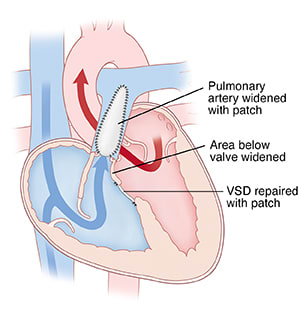
- The ventricular septal defect portion of TOF is most often closed with a patch. Tissue that causes a blockage at or below the pulmonary valve is removed as needed. The pulmonary artery or the branch pulmonary arteries may be made larger with a patch.
- Then your child is taken off the bypass machine and the chest is closed.
What happens after tetralogy of Fallot surgery?
Your child is taken to an intensive care unit (ICU) to be cared for and watched. Your child will have several catheters, tubes, and wires attached to them right after surgery. These are in place to help the ICU team care for your child. You can stay with your child during much of this time. They may stay in the hospital for at least 5 to 10 days. When your child is ready to leave the hospital, you'll be given directions for home care.
When to contact the doctor
Contact the doctor right away if your child has:
- Redness, fluid leaking, swelling, warmth, or bleeding at the incision site that gets worse.
- A fever of 100.4°F (38°C) or higher, or as directed by the child's doctor.
- Trouble feeding.
- Tiredness.
- A cough that won't go away.
- Nausea or vomiting that continues.
- Swelling or fluid buildup in the arms or legs.
- Dizziness.
When to call 911
Call
- Shortness of breath or trouble breathing.
- Chest pain.
- Irregular heartbeat.
- Fainting or unresponsiveness.
What are the long-term concerns?
Your child will need regular follow-up visits with a cardiologist for the rest of their life. More intervention on the pulmonary valve may be needed. This may include more surgery. Or it may include cardiac catheterization treatment. Your child may also develop heart rhythm problems as they get older. These may need to be treated.
After repair of TOF, most children can be active. The level and extent of physical activity will vary with each child. Check with the cardiologist about what activities are best for your child.
If your child is at high risk for a serious heart infection called infective endocarditis, your child may need to take antibiotics before having certain dental or other procedures, such as those that involve the oral or respiratory mucosa. Antibiotics should be taken exactly as directed.
Featured in



