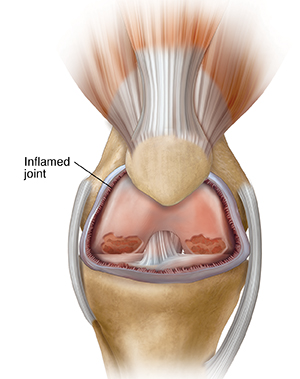
Psoriatic arthritis is joint pain and swelling that occurs in some people who have psoriasis. Psoriasis is a skin disease that causes scaly skin patches. People who have it may get psoriatic arthritis later. In some cases, the arthritis occurs before psoriasis.
How to say it
sor-ee-A-tik arthritis
What causes psoriatic arthritis?
Doctors don't know the exact cause of psoriatic arthritis. But it's linked to problems with the body’s infection-fighting system (immune system). Other factors include:
-
Family history. People who have psoriatic arthritis often have relatives with either psoriasis or arthritis, or both.
-
Certain infections. These include strep infections and HIV.
-
Environment. Stress, injury to skin, and certain medicines may trigger psoriasis to become active.
What are the symptoms of psoriatic arthritis?
Symptoms may include:
-
Pain, tenderness, and swelling in any joint, including the spine.
-
Joint or back stiffness, especially in the morning.
-
Patches of rough skin. They are usually red underneath and scaly and white or silver on top.
-
Fingernail problems. These may include pitted or crumbly nails, or nails that are detached from the nail bed.
-
Pain and swelling where muscles attach to bones.
-
Swelling of the fingers or toes.
-
Eye redness or inflammation.
How is psoriatic arthritis treated?
Psoriatic arthritis doesn't go away. It's a long-term (chronic) condition that needs long-term treatment. Medicines are an important part of treatment. These medicines may include:
-
Prescription or over-the-counter pain medicines. These help reduce swelling and pain.
-
Prescription medicines that limit the effect of the immune system. They may reduce or prevent joint damage. Methotrexate is a pill that's often used. Biologic and targeted synthetic medicines and skin patches may also be used.
-
Steroid injections in affected joints. These can help ease symptoms.
-
Topical medicines for rough skin patches. You put these on the skin to ease discomfort and dryness.
Your doctor may also recommend:
-
Regular exercise to improve flexibility and strength.
-
Physical therapy. It can help ease pain and improve flexibility.
-
Heat packs. They can help ease pain and swelling.
-
Shoe inserts to keep your feet and ankles stable. They can also help with foot pain.
What are the complications of psoriatic arthritis?
Possible complications include:
-
Joint damage that gets worse.
-
Reduced ability to use affected joints.
When should I call my doctor?
Contact your doctor right away if:
-
You have a fever of 100.4°F (38°C) or higher, or as directed by your doctor.
-
You have pain that gets worse.
-
You have symptoms that don’t get better or that get worse.
-
You have new symptoms.
Author: Freed, Becca
Online Medical Reviewer: Diane Horowitz MD
Online Medical Reviewer: Raymond Kent Turley BSN MSN RN
Online Medical Reviewer: Rita Sather RN
Date Last Reviewed: 06/01/2025
© 2000-2026 The StayWell Company, LLC. All rights reserved. This information is not intended as a substitute for professional medical care. Always follow your healthcare professional's instructions.


