Having a tracheostomy tube can affect your ability to talk and communicate with others. A speech therapist will work with you to address these problems. A speech therapist is a person trained to help people who have problems speaking. If you cannot talk, you can learn other ways to express your thoughts and feelings.
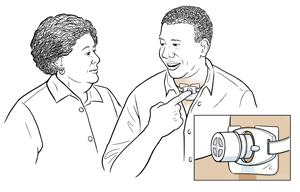
If you can talk
Whether you can talk depends on why you have the tracheostomy tube (trach tube). And it depends on other things, such as the health of your vocal cords. Many people with a trach tube still have vocal cords and can use them to talk.
Some trach tubes are designed to help with talking. Methods and devices have been developed to help redirect airflow up through the voice box to produce speech. One of these devices is a speaking valve. Your doctor will help you decide if a tube designed for talking is right for you.
If you cannot talk
If you cannot talk after your tracheostomy, you can communicate in other ways. The tips below can help you do this. Your speech therapist and the rest of your care team can also give you more suggestions.
-
Carry a pen and paper or a wipe-off board with you. Use them to write notes to show people.
-
On your smartphone, download "text to speech" apps. This technology produces speech from the text you type. Technology continues to advance. Your doctor can review options with you.
-
Use a tablet device such as an iPad to write notes to show people.
-
Use flash cards that say basic things, such as “thirsty” or “restroom.”
-
Try using a board with all the letters of the alphabet on it. Point to the letters to spell words.
-
Agree on the meanings of hand gestures with friends and family members.
-
Learn and use sign language.
-
Use facial expressions, such as a smile or frown. This can help others understand how you’re feeling.
New technology is available to support your communication. Your doctor can review options that may be right for you.
Online Medical Reviewer: Mary Mancini MD
Online Medical Reviewer: Ronald Karlin MD
Online Medical Reviewer: Stacey Wojcik MBA BSN RN
Date Last Reviewed: 05/01/2025
© 2000-2026 The StayWell Company, LLC. All rights reserved. This information is not intended as a substitute for professional medical care. Always follow your healthcare professional's instructions.


