The area between the chest wall and lung is called the pleural space. The lining around this space makes small amounts of fluid. This fluid helps lubricate the lining and allows the lungs to expand smoothly. Pleural effusion occurs when too much fluid builds up in the pleural space.
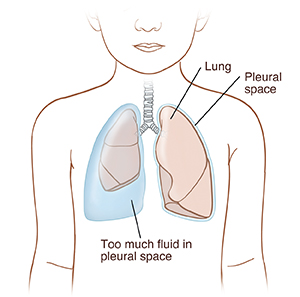
What causes pleural effusion?
Pleural effusion can occur if your child has a lung inflammation or infection. It can also happen if fluid builds up after surgery. Sometimes a pleural effusion may be caused by problems in the heart, kidney or liver. It can also be caused by an injury or other inflammatory diseases. If not treated, pleural effusion can lead to serious breathing problems. That’s why your child needs treatment right away.
What are the symptoms of pleural effusion?
Pleural effusion may not cause symptoms. If symptoms occur, they can include:
-
Shortness of breath or rapid breathing.
-
Cough.
-
Sharp chest pain that gets worse with coughing or deep breaths.
-
Fever.
-
Feeling tired (fatigue).
How is pleural effusion diagnosed?
Your child’s doctor listens with a stethoscope and taps on the chest. One or more of the following tests may be done to confirm the diagnosis:
-
Chest X-rays. These are taken in different positions to check if air or fluid is in the pleural spaces.
-
Ultrasound or CT scan. These are done if a chest X-ray does not give a clear picture. These tests may give a better picture of locations and pockets of fluid in the pleural space.
-
Pleural fluid analysis. A needle is passed into the pleural space to remove fluid. The fluid is then sent to a lab for testing.
How is pleural effusion treated?
Treatment depends on how much fluid is present and if it is infected.
-
If there is a small amount of fluid, it will likely go away on its own. The doctor will have you watch your child at home. No hospital stay is needed.
-
If your child has a lot of fluid or pus, is having trouble breathing, or is uncomfortable, they may need to stay in the hospital. They may have a thoracentesis. This is when a needle is put into the pleural space to remove extra fluid. Or, they may have a chest tube placed to drain the fluid.
-
If your child has an infection, antibiotics may be given to treat it.
-
The doctor will identify and treat any other underlying problem.
What are the long-term concerns?
Often, the causes of pleural effusion in children are less serious than for adults. Your child should have no long-term effects after the underlying problem is treated. The doctor can tell you more about your child’s condition and what to expect.
When to contact your child's doctor
Unless advised otherwise by your child’s doctor, contact them right away if your child:
-
Has trouble breathing.
-
Has rapid breathing.
-
Is coughing up blood.
-
Has chest pain that continues or gets worse.
-
Has a fever of
100.4 °F (38 °C) or higher, or as directed by your child's doctor. -
Has new symptoms, or has other symptoms that get worse.
Featured in
Online Medical Reviewer: Chelsey Schilling BSN RN
Online Medical Reviewer: Daphne Pierce-Smith RN MSN
Online Medical Reviewer: Mahammad Juber Medical Researcher
Date Last Reviewed: 06/01/2025
© 2000-2026 The StayWell Company, LLC. All rights reserved. This information is not intended as a substitute for professional medical care. Always follow your healthcare professional's instructions.


