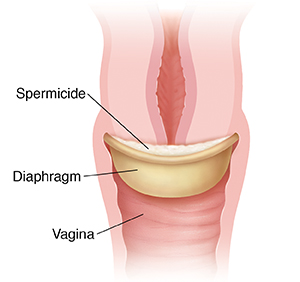
The diaphragm and the cervical cap are cup-shaped devices that are inserted into the vagina. They protect against pregnancy by covering the cervix. They keep sperm from entering the uterus to meet the egg.
Pregnancy rates
Talk with your doctor about the effectiveness of this birth control method.
Using the diaphragm or cervical cap
-
These devices must be fitted and prescribed by a doctor. The doctor will teach you how to insert them.
-
They must be used with spermicides. These are creams, foams, or gels that kill sperm.
-
The diaphragm can be inserted up to 2 hours before sex and the cervical cap up to 6 hours before sex.
-
The diaphragm can be left in place for up to 24 hours and the cervical cap for up to 48 hours.
Pros
-
Provides birth control right away.
-
Can be inserted ahead of time.
-
Easy to stop if you decide you want to become pregnant.
Cons
-
Requires planning ahead.
-
May be hard for some women to insert.
-
May increase the risk of urinary tract infection (UTI) or toxic shock syndrome (TSS). TSS is a rare but serious disorder caused by toxins released by certain bacteria.
-
Must be left in place for 6 to 8 hours after sex.
-
Cervical cap can’t be used during your period.
-
Cervical cap is much less effective for a woman who has given birth.
-
Cervical cap and diaphragm do not protect against sexually transmitted infections (STIs), including HIV. HIV is the virus that causes AIDS.
The diaphragm or cervical cap may not be for you
The diaphragm or cervical cap may not be for you if:
-
You're allergic to all spermicides.
-
You can't reach your cervix or insert the device correctly.
-
You aren't willing to plan ahead or interrupt sex to use it.
Featured in
Online Medical Reviewer: Donna Freeborn PhD CNM FNP
Online Medical Reviewer: Heather Trevino
Online Medical Reviewer: Irina Burd MD PhD
Date Last Reviewed: 07/01/2025
© 2000-2026 The StayWell Company, LLC. All rights reserved. This information is not intended as a substitute for professional medical care. Always follow your healthcare professional's instructions.


