Ultrasound is a common prenatal procedure. It's used to confirm your due date or check your baby’s health. It's used even in low-risk pregnancies. But if there are any concerns that your baby may be at risk, ultrasound can also help. It can give your healthcare provider the information they need. This helps to make sure that you and your baby get the best possible prenatal care.
Using sound waves to see your baby
During ultrasound, high-frequency sound waves pass through your body and your baby. Some of those sound waves reflect off your baby. They then return to a handheld device (transducer.) This device sends the information back to the ultrasound machine. A visual image is then created on a screen.
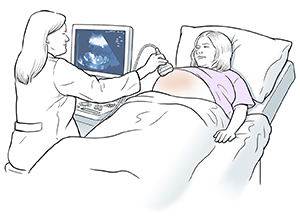
During ultrasound of the stomach
While you lie down on the exam table, a layer of gel or oil is put on your stomach. This helps the sound waves more easily reach your baby. Then the transducer is slowly moved back and forth over your stomach. The procedure is painless for baby and mother. It usually takes from about 10 minutes up to about 1 hour.
During vaginal ultrasound
The transducer is covered with a condom or other sterile latex or nonlatex shield. Then it's inserted, like a tampon, into your vagina. You may have little discomfort during the test just from the pressure of the transducer. It often takes less than 30 minutes.
Featured in
Online Medical Reviewer: Daniel N Sacks MD
Online Medical Reviewer: Donna Freeborn PhD CNM FNP
Online Medical Reviewer: Heather Trevino
Date Last Reviewed: 09/01/2025
© 2000-2026 The StayWell Company, LLC. All rights reserved. This information is not intended as a substitute for professional medical care. Always follow your healthcare professional's instructions.


