How is vaginal cancer diagnosed?
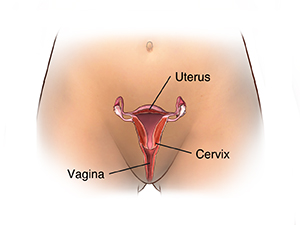
If your doctor thinks you might have vaginal cancer, you will need certain exams and tests to be sure. Diagnosing vaginal cancer starts with your doctor asking you questions. You will be asked about your health history, symptoms, risk factors, and family history of disease. A physical exam and a pelvic exam will be done. This allows your doctor to look at your vagina and feel other organs in your pelvis to check for tumors or lumps.
What tests might I need?
You may have one or more of these tests:
-
Pelvic exam. This exam of the vagina and pelvis allows your doctor to check for things that aren't normal, such as lumps. They can also check the size, shape, and position of your uterus and ovaries.
-
Pap test. This test is done during a pelvic exam. A swab is wiped on the cervix or vagina to pick up cells. The cells are then checked under a microscope. They’re checked for any signs of cancer or precancer, infection, or inflammation.
-
HPV (human papillomavirus) test. This test is done during a pelvic exam, usually at the same time as the Pap test. The test checks a sample of cells on the cervix for certain types of HPV infection.
-
Biopsy. A biopsy is when small pieces of tissue from the vagina are taken out and tested for cancer. A biopsy may be done during a colposcopy. It's the only way to know for sure that cell changes in the vagina are cancer and what type of cancer it is.
-
Colposcopy. This test uses a lighted magnifying tool called a colposcope to closely examine the cervix and vagina. The colposcope stays outside your body and the doctor looks through it. If abnormal tissue is found, a small piece of it may be removed so it can be checked for cancer. This is called a colposcopic biopsy.
Getting your test results
When your doctor has the results of your tests, they will contact you with the results. Your doctor will talk with you about other tests you may need if vaginal cancer is found. This may include repeating the biopsy or more tests. Make sure you understand the results and what you need to do next.
Featured in
Online Medical Reviewer: Donna Freeborn PhD CNM FNP
Online Medical Reviewer: Howard Goodman MD
Online Medical Reviewer: Jessica Gotwals RN BSN MPH
Date Last Reviewed: 06/01/2025
© 2000-2026 The StayWell Company, LLC. All rights reserved. This information is not intended as a substitute for professional medical care. Always follow your healthcare professional's instructions.