Labor is the series of uterine contractions that open (dilate) and thin (efface) your cervix for birth. Your due date is a guide to when labor will begin. But babies often come days or weeks before or after due dates. Even so, labor need not take you by surprise. In the last weeks of pregnancy, you or your healthcare provider may notice changes that mean labor is near.
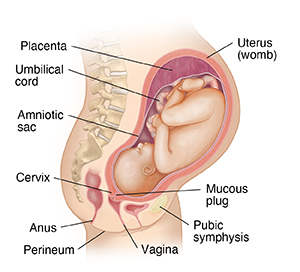
-
The placenta and umbilical cord send nourishment to the baby.
-
The amniotic sac (bag of water) holds the fluid that surrounds your baby in the uterus.
-
The uterus (womb) holds the baby as it grows.
-
The cervix is the narrow opening of the uterus.
-
The vagina is the birth canal.
-
The mucous plug helps keep bacteria out of the uterus.
-
The perineum is the area between the vaginal opening and the anus.
-
The pubic symphysis joint lies between the pelvic bones and allows the baby to pass through.
Changes in your body
Physical changes often signal that your baby will soon be born:
-
Discharge from your vagina may increase and become thicker. You may notice a pink or brownish discharge called the bloody show.
-
The mucous plug may break down over a few weeks or all at once. Losing the plug doesn’t mean that labor will start right away.
-
You may feel Braxton Hicks contractions (false labor). These irregular contractions start to soften and thin the cervix. Many women mistake these contractions for true labor. They may be more noticeable toward the end of the day.
-
Feeling like the baby has dropped lower. In preparation for birth, the baby's head has settled deep into your pelvis.
Featured in
Online Medical Reviewer: Donna Freeborn PhD CNM FNP
Online Medical Reviewer: Heather Trevino
Online Medical Reviewer: Irina Burd MD PhD
Date Last Reviewed: 03/01/2024
© 2000-2026 The StayWell Company, LLC. All rights reserved. This information is not intended as a substitute for professional medical care. Always follow your healthcare professional's instructions.


