Related Conditions

Pregnancy: Subchorionic Hematoma

Choose a preferred language


Overview

../images/e83b7541923951131e6d3588169a4521.jpg

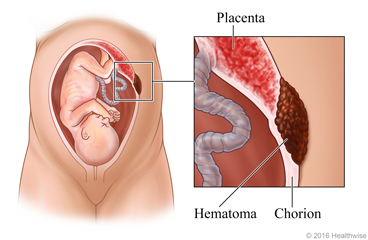
A subchorionic hematoma or hemorrhage is bleeding between the wall of the uterus and one of the sacs
(chorion) that surrounds the embryo inside the uterus. It is a common cause of bleeding in early pregnancy.

The main symptom is vaginal bleeding. But some people don't have symptoms. They may find out they have a
hematoma during an ultrasound test.

In most cases, the bleeding goes away on its own. Most people go on to have a healthy baby. But in some
cases, the bleeding is a sign of a miscarriage or other problem with the pregnancy. Your doctor may want to do
a follow-up ultrasound.

Follow-up care is a key part of your treatment and safety. Be sure to make and go to all
appointments, and call your doctor if you are having problems. It's also a good idea to know your test results
and keep a list of the medicines you take.

How can you care for yourself at home?

  • Keep track of any bleeding, and follow the guidelines for when to call your doctor.

  • Keep in mind that some bleeding during the first trimester or an abnormal finding on an ultrasound may:

    • Not cause any problems for you or the baby.

    • Turn out to be something more serious. But if this happens, it's best to find out early. Then you and
      your doctor can manage any complications sooner rather than later.

When should you call for help?

../images/Call-for-help_icn.jpgCall 911
anytime you think you may need emergency care. For example, call if:


  • You have sudden, severe pain in your belly or pelvis.


  • You passed out (lost consciousness).


  • You have severe vaginal bleeding. This means you are soaking through a pad each hour for 2 or more
    hours.

Call your doctor now or seek immediate medical care if:


  • You are dizzy or lightheaded, or you feel like you may faint.


  • You have new or increased pain in your belly, pelvis, or lower back.


  • You have new or more vaginal bleeding.


  • You think you may have passed pregnancy tissue. Save any tissue that you pass. Take it to your
    doctor's office as soon as you can.


  • You think that you are in labor.


  • You have a sudden release of fluid from your vagina.


  • You've been having regular contractions for an hour. This means that you've had at least 8
    contractions within 1 hour or at least 4 contractions within 20 minutes, even after you change your
    position and drink fluids.


  • You notice that your baby has stopped moving or is moving much less than normal.

Watch closely for changes in your health, and be sure to contact your doctor if you have
any problems.

Current as of: July 10, 2023

Content Version: 14.0

Care instructions adapted under license by your
healthcare professional. If you have questions about a medical condition or this instruction, always ask
your healthcare professional. Healthwise, Incorporated disclaims any warranty or liability for your use of
this information.

Featured in

© 2006-2026 Healthwise, Incorporated.

Make an Appointment

Make an Appointment

Find a Doctor

Find a Doctor

Find a Location

Find a Location
Related Articles
Read article
OB/GYN
Pregnancy and Pre-existing Heart Disease

Pre-existing heart disease is a heart problem that you had before you got pregnant. This often means a heart condition that you were born with (congenital).

Read article
OB/GYN
Epilepsy During Pregnancy

Epilepsy is a disorder of the nervous system. It is also called a seizure disorder. Normally the body's nerves send information by electrical and chemical signals. People with epilepsy have abnormal electrical signals in the brain. This can cause a seizure.

Read article
OB/GYN
Cholestasis of Pregnancy

Cholestasis of pregnancy is a liver problem. It slows or stops the normal flow of bile from the gallbladder. This causes itching and yellowing of your skin, eyes, and mucous membranes. Cholestasis sometimes starts in early pregnancy. But it is more common in the second and third trimesters.

Read article
OB/GYN
Common Discomforts During Pregnancy

Nausea and vomiting are common in the first trimester, as is fatigue. Other common discomforts are hemorrhoids and heartburn.


