You likely position yourself differently now than you did before you were pregnant. Did you know that standing, sitting, or lying in certain ways can lead to back pain? To ease pain, use positions that support your body comfortably.
Tips for good posture
Using good posture means holding yourself so that your spine is aligned and your muscles can work without strain. To use good posture:
-
Raise your chest and head. Try to keep your ears lined up over your shoulders.
-
Use your stomach muscles to pull in your stomach. This reduces the amount of weight your back must support.
-
Keep your pelvis level. Think of your pelvis as a bowl of water that will spill if it tips too far forward or backward.
Standing
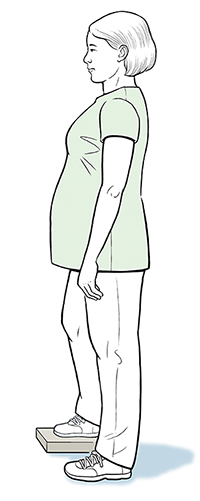
If you must stand for long periods, try to change positions every
-
Keep your legs slightly apart. This helps you balance your weight.
-
Rest one foot on a book, ledge, or low stool. Every few minutes, switch legs.
-
Wear comfortable shoes with padded soles and arch support, like athletic shoes.
Sitting
When sitting in a chair or car, make sure your spine’s lumbar curve is supported. Use a chair with lumbar support built in, or put a firm pillow against your lower back. Also try the following:
-
Sit with your knees slightly lower than your hips. Don’t cross your legs.
-
Take deep breaths often. This helps keep your spine and stomach in the best position.
-
Vary your activity each hour. For instance, get up from your desk and take a
5 -minute walk around the office.
Lying down
To lie safely and comfortably:
-
Lie on your side with your knees slightly bent. This takes pressure off your uterus and improves blood flow to your baby.
-
Place pillows under your abdomen and between your knees.
-
To get out of bed, while on your side, use your arms to push yourself into a seated position. Scoot to the edge of the bed and place your feet on the floor. Lean forward, then use your leg muscles to stand.
-
Consider investing in a firm mattress.
Lifting
Tip to safely lift:
-
Don't bend over from the waist to pick things up. Squat down, bend your knees, and keep your back straight.
Featured in
Online Medical Reviewer: Donna Freeborn PhD CNM FNP
Date Last Reviewed: 03/01/2024
© 2000-2026 The StayWell Company, LLC. All rights reserved. This information is not intended as a substitute for professional medical care. Always follow your healthcare professional's instructions.


