If your pelvic organ prolapse is mild or doesn’t bother you much, or if you have health conditions that make surgery too risky, nonsurgical treatment may be a good choice. A device (pessary) to wear in your vagina can help ease your symptoms. You may also be given certain pelvic floor muscle exercises to do. And you may need to make some lifestyle changes.
Wearing a pessary
A pessary helps support the prolapsed organ or organs. It is specifically fitted by your healthcare provider. A pessary may ease your symptoms, but it can’t repair prolapse. The pessary must be removed for cleaning. If you can’t do this, you will need to see your healthcare provider regularly. They will remove and clean your pessary. If you have questions or concerns about the pessary, be sure to talk with your healthcare provider.
Doing pelvic floor muscle exercises
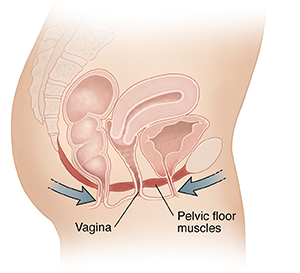
Simple exercises can help strengthen the pelvic floor muscles. They may ease your symptoms and prevent further prolapse. One simple exercise is done by contracting your pelvic floor muscles as if to stop the urine stream. (Do this when you’re not urinating.) Ask your healthcare provider how many contractions to do and how long to hold each one. During your treatment visits, your healthcare provider may place a device in your vagina to measure your muscle contractions. That way, you can find out if you are doing the exercises correctly.
Other tips
Improving your health may ease your symptoms or keep your problem from getting worse. You may be asked to:
-
Quit smoking to prevent excessive coughing
-
Adjust medicines that may cause urine leakage
-
Limit fluid intake if incontinence is a problem. This includes limiting drinks that contain caffeine (a diuretic). Emptying your bladder at scheduled times (bladder training) also may be useful if you have incontinence.
-
Not do any lifting, which puts pressure on pelvic muscles
-
Exercise and eat well to stay at a healthy weight
Featured in
Online Medical Reviewer: Donna Freeborn PhD CNM FNP
Online Medical Reviewer: Heather M Trevino BSN RNC
Online Medical Reviewer: Irina Burd MD PhD
Date Last Reviewed: 09/01/2026
© 2000-2026 The StayWell Company, LLC. All rights reserved. This information is not intended as a substitute for professional medical care. Always follow your healthcare professional's instructions.


