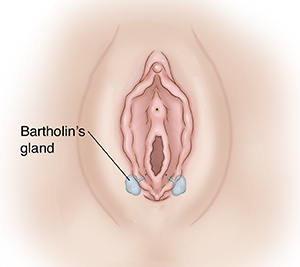
The Bartholin’s glands are a pair of very small glands found inside the labia (vaginal lips). There is one gland on either side. The glands produce fluid to help keep the vagina moist. When the opening of a Bartholin’s gland becomes blocked, the gland may swell and form a cyst. The cyst may vary in size from small to large (1 to 5 cm in size). It may feel like a firm lump within the labia.
Treatment depends on various factors. These include the size of the cyst, whether it causes symptoms, and whether it’s infected. Small or uninfected cysts don’t usually need treatment. Large cysts and those that are painful or infected will likely need treatment. Below are some common treatments that may be done:
-
Incision and drainage. In this procedure, the area over the cyst is numbed, cut, and drained. Often, a thin tube (catheter) with a balloon on the end or a short piece of gauze is then inserted into the empty cyst. This allows for further drainage of fluid. The catheter is left in place for 4 to 6 weeks, then removed by the doctor. If gauze has been placed in the cyst, it needs to be removed within several days.
-
Marsupialization. With this procedure, the area over the cyst is numbed. The cyst is cut and drained. The edges of the skin are then stitched to create a small opening that will allow for further drainage of fluid.
-
Excision. This procedure is done in the operating room. It is often used if other treatments haven't worked.
If you have cysts that keep coming back, you may need other treatments. Your doctor can tell you more about these options.
If your cyst is infected, your doctor may prescribe antibiotics. Most infections of Bartholin’s cysts are from bacteria normally present in the vagina. Sometimes the bacteria may have been passed to you during sex. This is called a sexually transmitted infection (STI). A test (culture) of the fluid can confirm if you have an STI.
Home care
Medicines
-
If antibiotics are prescribed, be sure to take them exactly as directed. Don’t stop taking the medicine, even if you start to feel better. If the cause of your infection is an STI, any sexual partners you have will also need to be tested and treated.
-
If you have pain, use over-the-counter pain medicine as directed. If needed, stronger pain medicines can be prescribed.
General care
-
To help relieve discomfort, you may be advised to take sitz baths for the next few days. For this, you soak in a bath filled with 2 to 3 inches of warm water for 10 to 15 minutes, a few times a day.
-
Don't have sex until the cyst has healed. If the cause of your infection is an STI, don't have sex until you and any partners you have are done with treatment.
Follow-up care
Follow up with your doctor as directed. Be sure to keep all appointments. These are needed to ensure that you are recovering well after your treatment. If you have a catheter or gauze in the cyst, your doctor will let you know when to return to have it removed.
When to get medical advice
Contact your doctor right away if you have:
-
A fever that does not go down or gets worse.
-
Increased redness, pain, swelling, or foul-smelling drainage from the cyst or the area around it.
-
Pain in the lower abdomen.
-
A new rash or joint pain.
-
A catheter that falls out before the scheduled time to remove it.
Featured in
Online Medical Reviewer: Daniel N Sacks MD
Online Medical Reviewer: Donna Freeborn PhD CNM FNP
Online Medical Reviewer: Heather Trevino
Date Last Reviewed: 07/01/2025
© 2000-2026 The StayWell Company, LLC. All rights reserved. This information is not intended as a substitute for professional medical care. Always follow your healthcare professional's instructions.


