A cyst is often a fluid-filled sac, like a small water balloon. Cysts are almost always harmless, and many go away on their own. Often they grow slowly. They can vary in size from as small as a pea to larger than a basketball. Many cause no symptoms at all. Often they are felt only during a pelvic exam. Ovarian cysts are usually not cancer (benign).
Functional cyst
A functional cyst is the most common kind of cyst. It forms when a follicle doesn't release a mature egg or continues to grow after releasing the egg. Functional cysts often occur on only one ovary at a time. They often shrink on their own in 1 to 3 months. In rare cases, a cyst will break open (rupture), causing pain. Pain might also be caused by the twisting of an ovary that is enlarged because of the cyst growing on it.
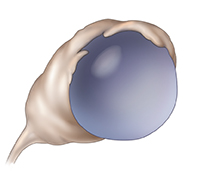
Dermoid cyst
Sometimes cells that are present from birth in the ovary, will start to grow into different kinds of tissue such as skin, fat, hair, and teeth. This kind of cyst is called a dermoid cyst. Dermoid cysts can grow on one or both ovaries. Often they cause no symptoms. But if they leak or the ovary becomes twisted, they can cause severe pain.
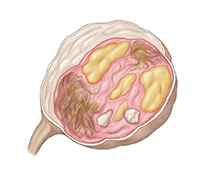
Endometrioma
Sometimes tissue similar to the lining of the uterus (endometrium) grows and becomes part of the ovary. This kind of cyst is often called a chocolate cyst because of its dark brown color. These cysts can grow on one or both ovaries. They often cause pain, especially around menstruation or during sex.
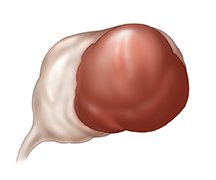
Benign cystadenoma
If the capsule around the ovary grows and fills with fluid, it can form a cystadenoma. These cysts can grow on one or both ovaries. Often they cause no symptoms if they are small. But if they become large, they can press on organs near the ovaries, causing pain. They can also cause pain by stretching the ovarian capsule. A cyst that pushes on the bladder can cause frequent urination. Sometimes these cysts break open and bleed.
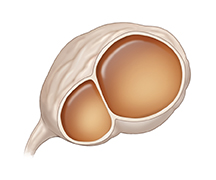
Cancer (malignant) cysts
These cysts can invade other tissues or spread to other parts of the body.
Featured in
Online Medical Reviewer: Donna Freeborn PhD CNM FNP
Online Medical Reviewer: Howard Goodman MD
Online Medical Reviewer: Stacey Wojcik MBA BSN RN
Date Last Reviewed: 09/01/2025
© 2000-2026 The StayWell Company, LLC. All rights reserved. This information is not intended as a substitute for professional medical care. Always follow your healthcare professional's instructions.


