Cancer starts when cells in the body change and grow out of control. Cancer cells can form lumps of tissue called tumors. Cancer that starts in the cells of the prostate is called prostate cancer. It can grow and spread beyond the prostate. Cancer that spreads is harder to treat.
Understanding the prostate
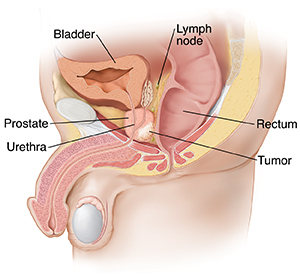
The prostate is a gland in men about the size and shape of a walnut behind the base of the penis. It wraps around the upper part of the urethra. This is the tube that carries urine from the bladder through the penis and out of the body. The prostate makes some of the fluid that’s part of semen. During orgasm, semen comes out of the body through the urethra.
When prostate cancer forms
As a man ages, the cells of his prostate often grow bigger. Most older men notice a change in their urine flow related to an enlarging prostate.
-
Noncancerous (not cancer). As a man ages, the prostate tends to get bigger. This is called benign prostatic hyperplasia (BPH). With BPH, the extra prostate tissue often squeezes the urethra, causing symptoms, such as trouble passing urine. But BPH is not cancer, and it doesn't lead to cancer.
-
Atypical cells. Sometimes prostate cells don’t look like normal (typical) prostate cells. One type of abnormal growth is called prostatic intraepithelial neoplasia or PIN. PIN cells are not cancer cells. But if the pattern of cells is very abnormal (called high-grade PIN), there's about a 1 in 5 chance that there might be cancer in another part of the prostate, or on a future biopsy.
-
Cancer. A diagnosis of prostate cancer needs a biopsy of the prostate. A pathologist looks at the biopsy sample under a microscope. If the tissue structure looks disorganized and the prostate cells look abnormal, the pathologist may diagnose prostate cancer. If the prostate cells have invaded other tissues, they're called cancer cells. Some tumors can be felt during a physical exam, but depending on the location of the cancer in the prostate, some cannot be felt. Over time, prostate cancer may grow into nearby tissue or organs, or spread to nearby lymph nodes. Lymph nodes are small organs around the body that are part of the immune system. In some cases, the cancer spreads to bones or organs in distant parts of the body. This is called metastasis.
Diagnosing prostate cancer
Prostate cancer may not cause symptoms at first. Urinary problems are often not a sign of cancer, but of another condition, such as BPH. If your doctor thinks you may have prostate cancer, they will ask about your symptoms, health history, and family history. They may do a digital rectal exam, by inserting a finger into your rectum to feel for lumps on your prostate. Other common tests include:
-
Prostate specific antigen (PSA) testing. This is a blood test. PSA is a chemical made by prostate cells. The amount of PSA in the blood (PSA level) can be tested to check for prostate cancer. In general, a high or rising PSA level may mean there's cancer. What is considered a normal PSA increases with age.
-
Core needle biopsy. This test is needed to know for sure if a man has prostate cancer. A hollow needle is used to take tiny pieces of tissue from the prostate. During the test called a transrectal ultrasound guided biopsy, a small probe is put into the rectum. The probe sends an image of the prostate to a video screen. With this image as a guide, the doctor uses a thin, hollow needle to remove tissue samples from all over the prostate. These are sent to a lab where they are looked at and tested for cancer cells.
Ask your doctor what tests you will need and what to expect.
Featured in



