What is cancer?
Cancer starts when normal cells in the body change (mutate) and grow out of control. To help you understand what happens when you have cancer, let's look at how your body works normally. Your body is made up of tiny building blocks called cells. Normal, healthy cells grow when your body needs them, and die when your body doesn't need them any longer.
Cancer is made up of abnormal cells that grow even though your body doesn't need them. In most cancers, the abnormal cells grow to form a lump or mass called a tumor. If cancer cells are in the body long enough, they can grow into (invade) nearby areas. They can even spread to other parts of the body (metastasize).
What is adrenal cancer?
Adrenal cancer is a rare cancer that starts in one or both adrenal glands.
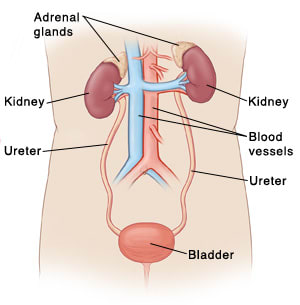
Anatomy of the adrenal glands
There are two adrenal glands. One sits on top of each kidney. The two kidneys are located deep inside the upper part of the belly (abdomen). The outer part of the adrenal gland is called the adrenal cortex. Most adrenal cancers start in this part. The inner part is called the adrenal medulla.
The adrenal glands make important hormones that:
- Control how much sodium and potassium are in body fluids
- Make small amounts of the male and female sex hormones
- Help control heart rate, blood pressure, and the digestive and respiratory systems
- Control how the body gets energy from (metabolizes) protein, fat, and carbohydrates
- Help the body react to stress
Types of adrenal gland tumors
Cancer that starts in the adrenal glands is rare. Most tumors in the adrenal glands are not cancer (they're benign). To diagnose adrenal cancer, blood and urine tests are done along with imaging scans and biopsy.
Tumors that start in the adrenal glands include:
- Adenoma. This is the most common kind of adrenal gland tumor. It's not cancer. These tumors tend to be small (less than 2 inches across). In most cases, they don't cause symptoms or problems. So people don't know they're there. Adenomas are often found when a scan of the belly is done for a different health problem. The tumor may or may not produce hormones.
- Adrenal cancer (adrenocortical carcinoma). This kind of cancer is rare. But it's the most common type of adrenal gland cancer. It starts in the cortex, or outer part, of the adrenal gland. It may be a functioning tumor. This means it makes one or more adrenal hormones. Or it may be nonfunctioning, so it doesn't make hormones.
- Pheochromocytoma. This is a growth that makes hormones inside the adrenal glands in the adrenal medulla. In most cases, it's not cancer. This growth can also start in other parts of the body. But it's most often in the adrenal gland.
- Neuroblastoma. This rare childhood cancer most often begins in the adrenal glands. But it can also start in the neck, chest, or spinal cord. The tumor is often formed in early childhood. But it may not be found until later, when it grows and causes symptoms.
Most cancer tumors in the adrenal glands don't start there. They're tumors caused by cancer that started in another part of the body. The cells spread (metastasized) to the adrenal gland and form a tumor there. For instance, lung cancer tends to metastasize to the adrenal glands. In this case, the cancer cells in the adrenal gland look like and are treated like lung cancer. The cancer is called metastatic lung cancer, not adrenal cancer.
It's important to know if a tumor started in the adrenal gland, which is called a primary tumor, or is a metastatic tumor that spread from cancer in another part of the body. Tests will be done to find out.
Contact your doctor
If you have questions about adrenal cancer, talk with your doctor. Your doctor can help you understand more about this cancer.
Featured in
Date Last Reviewed: 09/01/2025
© 2026 The StayWell Company, LLC. All rights reserved. This information is not intended as a substitute for professional medical care. Always follow your healthcare provider's instructions.


